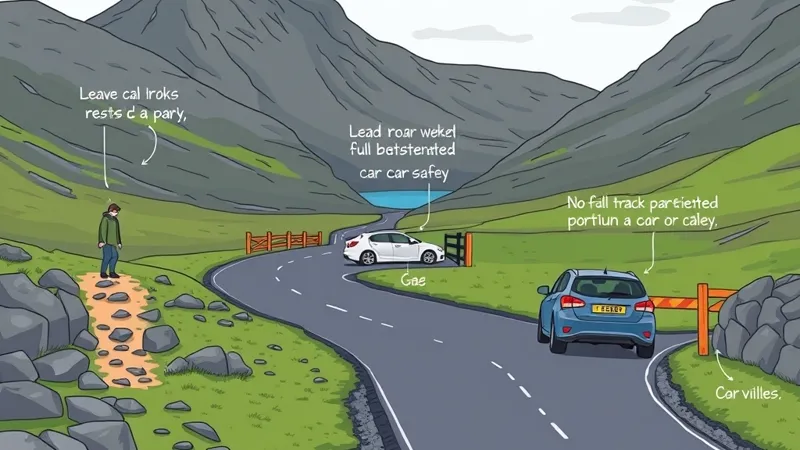
How can you leave no trace when visiting Skye?
Leave stones where they are, avoid building spirals or cairns, park only in permitted spaces and never park in passing places. Take rubbish away and change your plans when access, weather or ground conditions require it.
Use this practical checklist:
- Leave natural objects and existing structures undisturbed.
- Check parking signs before leaving your vehicle.
- Move on safely when no permitted space is available.
- Carry out litter, food scraps and sanitation waste.
- Choose walks suited to your group and the conditions.
The Scottish Outdoor Access Code explains responsible access; it does not grant permission to park a vehicle. Parking restrictions and road rules have a separate basis: follow local signs and Highland Council parking information, and remember that the Highway Code says not to park in passing places.
Why should visitors leave stones rather than build spirals or cairns?
Leave stones in place: moving them can disturb small habitats and change the landscape other visitors came to see. NatureScot provides the conservation context for protecting habitats; there is no need to exaggerate the damage caused by an individual arrangement to justify leaving nature alone.
The Fairy Glen's stone spirals are visitor-made, not evidence of local folklore. Do not add to them or create another arrangement for a photograph.
Equally, do not dismantle an unidentified cairn. A decorative stack, possible navigation marker and archaeological feature are not interchangeable. Historic Environment Scotland provides guidance on protecting heritage: leaving uncertain structures untouched avoids accidental damage in the name of tidying up.
What should you do when a Skye car park is full?
Check the signs, use a permitted space if one is available, and otherwise leave safely to choose a lawful alternative or postpone the stop.
- Read restrictions before entering or manoeuvring.
- Use a marked or otherwise clearly permitted space without obstructing access.
- If none is available, leave without blocking circulation.
- Reconsider the stop rather than assuming a space will become available later.
Under the Highway Code's parking guidance, vehicles must not create dangerous positions or unnecessary obstruction. Gates, footways and passing places are not overflow parking; nor should you assume that a verge is available simply because another driver has used it. Check Highland Council information and on-site restrictions.
An alternative destination needs its own lawful parking and suitable access. Moving congestion to the next roadside entrance is not a solution.
How do passing places work on Skye's single-track roads?
Use passing places to keep traffic moving, not to park or take photographs. Highway Code Rule 155 explains the procedure:
- Pull into a passing place on your left, or wait opposite one on your right.
- Let approaching traffic pass and allow following traffic to overtake.
- Give way to uphill traffic whenever possible.
- Reverse if necessary until you reach a passing place.
Do not cross into a right-hand passing place merely because it looks convenient. Staying predictable matters more than waving another driver through while blocking their route. For photographs, continue to a permitted parking area.
How can walkers protect paths while choosing a suitable route?
Choose a route your group can manage, then avoid unnecessary damage while walking it. The Scottish Outdoor Access Code supports responsible route choices, avoiding damage and keeping dogs under appropriate control, particularly around livestock and wildlife.
Stay on established paths where practical. Avoid shortcuts and repeated detours that widen worn ground; if continuing means unsuitable terrain or damaging vegetation, turn back rather than forcing the itinerary.
Skye's famous walks are not uniformly easy. The Storr site manager describes its path as steep and exposed. Walkhighlands' Skye route guides classify the Quiraing circuit as Hard; that assessment applies to the described route, not every possible walk nearby. Mud, scree and sections close to cliff edges matter more than a short-looking line on a map.
For visitors without mountaineering experience, our recommendation is to undertake Cuillin mountain routes only with a qualified guide. This is a safety recommendation for this audience, not a claim that every path near the Cuillin has the same difficulty or a legal guide requirement.
How should weather and closures change your plans?
Treat every outdoor stop as conditional: cloud, wind, closures and unsuitable ground can change the day's programme. Overcast conditions belong in normal planning, and clear views are never guaranteed.
Dunvegan Castle advises that high winds can cause short-notice closure of the castle and gardens. Snow or ice can close the Quiraing road; check Highland Council road notices rather than assuming a planned route remains open.
Consult Met Office forecasts and warnings before setting out. A forecast does not guarantee conditions at an exposed viewpoint. Choose a suitable alternative or abandon the stop when necessary; a booking does not override a closure.
How should you handle litter, toilets and overnight stays?
Take all litter and food scraps away, plan toilet stops and keep waste out of watercourses. The Scottish Outdoor Access Code explains responsible camping, waste disposal and avoiding fires that damage vulnerable ground.
Carry a rubbish bag, use public toilets where available and do not leave wipes, toilet paper or other sanitation waste behind. Check Highland Council for facilities and local restrictions rather than assuming every viewpoint has toilets.
The Code distinguishes responsible lightweight tent camping from motorised access: access rights do not grant vehicle access or overnight parking. For a campervan or car, establish whether that particular location permits an overnight stay. Follow signs and use appropriate waste-disposal facilities, not drains or streams.
Can you reduce parking pressure by visiting Skye without a car?
Yes, but plan around actual connections rather than expecting public transport to reach every trailhead.
Research rail journeys to Inverness, Kyle of Lochalsh or Mallaig with ScotRail, onward coaches with Scottish Citylink and local buses with Stagecoach. For the Mallaig–Armadale ferry, consult CalMac. Check the complete outward and return journey: services may be limited, connections are not guaranteed and disruption can affect the whole plan.
Our getting-there guide helps with car-free planning, while the accommodation guide can help you consider Portree as a base.
An Inverness day-trip option may reduce individual car use. For a longer visit, compare three-day and five-day Skye tours, checking departure points and inclusions individually.
Isle of Skye Guide is an independent affiliate guide, not a tour operator. Live prices and ratings belong in the GetYourGuide widgets on tour pages. Tours can still lose stops to closures; never assume an Edinburgh day trip reaches Skye or that a Jacobite steam-train seat is included or guaranteed.
What do visitors ask about leaving no trace on Skye?
Responsible visiting means leaving places undisturbed and accepting that access is conditional.
Can I build stone spirals or remove existing cairns?
Leave stones in place and do not add decorative arrangements. Do not dismantle unidentified cairns: they may have navigation or heritage significance. Follow the Scottish Outdoor Access Code and Historic Environment Scotland guidance.
Can I stop in a passing place for photographs or wait for parking?
Passing places are not parking or photo stops, according to the Highway Code. If a car park is full, leave safely unless a clearly permitted waiting arrangement exists; a space becoming free is never guaranteed.
Is every popular Skye walk easy?
No. Storr is steep and exposed, and Walkhighlands grades its Quiraing circuit Hard. Choose the specific route for your abilities and conditions, not its popularity.
Do access rights allow overnight vehicle parking?
No. The Scottish Outdoor Access Code does not grant motorised access or parking rights. Check local signs and Highland Council information for the particular location.
Can I visit Skye without a car?
Yes, using rail, coaches, buses and relevant ferry connections. Check operators' timetables and return options; do not assume frequent services, guaranteed connections or access to every walk.
Sources
These sources provide responsible-access guidance, route descriptions and information to consult before travel.
- NatureScot and the Scottish Outdoor Access Code: habitat protection, responsible access, dogs and camping.
- The Highway Code: single-track roads and passing places, particularly Rule 155.
- Highland Council: parking, facilities, restrictions and road notices.
- Historic Environment Scotland: protection of archaeological and historic features.
- Met Office: forecasts, warnings and official climate information; no climate figures are used here.
- Walkhighlands: specialist route descriptions, including the Quiraing circuit; not an access authority.
- Dunvegan Castle: attraction access and weather-related closure information.
- ScotRail, Scottish Citylink, Stagecoach and CalMac: official journey planning and service notices.