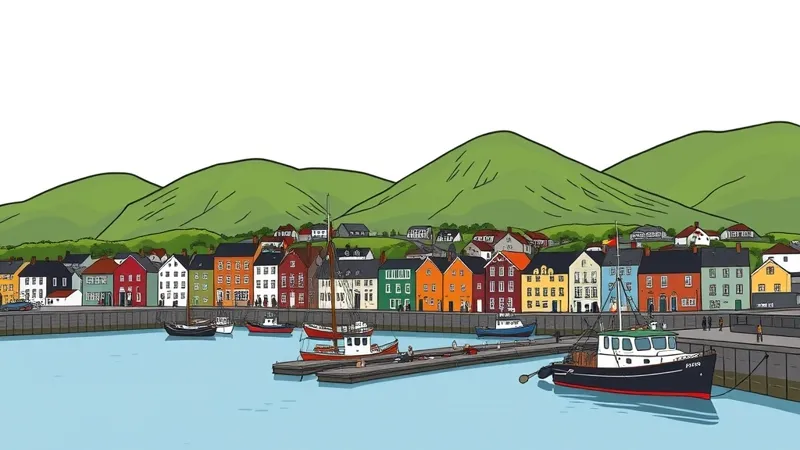
How did Portree become the capital of Skye?
Portree became Skye’s capital gradually, as a harbour settlement associated with fishing and maritime trade developed into the island’s principal service and visitor centre. Its sheltered harbour, estate-led village development, transport connections and concentration of services mattered more than any single founding event.
“Capital” describes that practical role; it does not imply a formal declaration. Fishing belongs in the story, but cannot explain the town alone. Commerce, accommodation and services helped turn a place where boats landed into somewhere islanders and visitors travelled to for other reasons.
The useful distinction is between the harbour settlement, the later planned village and today’s service centre. Historic Environment Scotland provides architectural and historical research resources for exploring those overlapping layers.
What does the name Portree mean, and how old is the settlement?
Port Rìgh is commonly translated as “king’s port”, but the translation does not establish how the name originated. A royal visit is a familiar explanation; it should be treated as tradition rather than proof of the settlement’s foundation.
Competing explanations concern the name’s earlier forms and interpretation. Gaelic place-name scholarship, particularly Ainmean-Àite na h-Alba, is more useful here than repeating a picturesque story as settled history.
The harbour settlement and the later planned village are not interchangeable. People could use a landing place before streets and plots acquired their recognisable arrangement. Conversely, a village appearing on a map does not reveal its earliest occupation. The National Library of Scotland’s historic maps offer a way to compare the mapped settlement without assigning an unsupported foundation date.
How did fishing, trade and estate planning shape Portree?
Harbour activity and estate planning worked together; fishing alone did not create the modern town. The simplest useful sequence separates the functions of the waterfront from the organisation of the village behind it:
- Harbour settlement: fishing and maritime exchange gave the waterfront an economic purpose.
- Planned expansion: estate-led development shaped streets and building plots, giving commercial activity a more organised setting.
- Service centre: shops, accommodation and other services reinforced the village’s importance beyond the boats themselves.
Historic maps document layouts at particular moments. Explaining who commissioned development, how plots were leased or why investment occurred requires different evidence, including estate records held through collections such as those of National Records of Scotland.
The broader interpretation is that a useful harbour and an organised settlement supported each other. That is more convincing than imagining a fishing village becoming a capital overnight.
How did maritime travel and public services strengthen Portree’s role?
Maritime travel brought passengers and commerce, while services gave people reasons to return. Historic passenger shipping belongs to the explanation of Portree’s growth, alongside the accommodation and businesses serving arrivals.
A service centre becomes important through repeated everyday journeys: shopping, education, administration and access to care. Those functions help explain Portree’s island role, but the founding dates and influence of particular institutions need their own documentary evidence. Highland Archive Service and Historic Environment Scotland are relevant collections for that institutional history.
Historic shipping should not be confused with present transport. Contemporary car-free journeys normally involve road transport for the final approach, rather than a mainland passenger ferry arriving in Portree.
What does being the capital of Skye mean today?
Today, “capital of Skye” means Portree is the island’s principal town and a practical concentration of services. It is neither a national capital nor an independent local-government area: local-government responsibilities sit within Highland Council.
Shops, schools, accommodation, places to eat and visitor facilities give the town a role beyond its harbour frontage. Highland Council is the appropriate reference for public services; VisitScotland provides visitor information.
That does not mean every island service is based here. Skye has other communities and gateways, and choosing Portree as a base should depend on your plans rather than the capital label alone.
Where can visitors see evidence of Portree’s history?
The harbour frontage and streets around Somerled Square offer a compact introduction to Portree’s development. A self-guided exploration can be adapted to the weather and your mobility.
Start around Somerled Square, observing how streets, businesses and public space fit together. Continue towards the harbour if the weather and gradients suit you. From the waterfront, look back at the relationship between the landing place and the town above.
Street alignment, building proportions and the relationship between plots can reveal more than colour alone. The familiar painted frontage is not evidence that every present finish is historic. Likewise, a plaque, name or decorative feature does not establish a building’s age.
Historic Environment Scotland’s designation records are the appropriate reference for individual listed buildings and their significance. A building’s historical interest is separate from whether its interior is open to visitors.
Gradients, possible steps and slippery wet surfaces mean this is not a universally accessible promenade. Harbour operations can also affect which parts of the waterfront are suitable for sightseeing.
How can you reach Portree without a car from Edinburgh or Inverness?
Portree has no railway station, so rail journeys require an onward road connection. From Edinburgh, a practical planning option is rail to Inverness followed by a coach to Portree. Edinburgh does not have a direct coach to Portree; coach-only journeys require a change, such as through Glasgow or Inverness.
Check the rail leg with ScotRail and onward coaches with Scottish Citylink. Select your travel date before assuming that connections work, and leave room for delays rather than treating separate services as a guaranteed connection.
For onward island travel, consult Stagecoach for relevant local services. No departure times or frequencies are quoted here because seasonal timetables can change.
Is Portree a useful overnight base for exploring Skye?
Portree is useful without a car when you value central services, but it is not a guarantee of convenient transport to rural attractions. Staying centrally can simplify meals, shopping and departures. Check the actual position of accommodation: a Portree address does not necessarily mean an easy walk from your arrival stop.
Our accommodation guide can help frame that choice. Before booking, match your intended excursions to official bus timetables, including the return journey.
A tour can reduce transport planning, but its stops and overnight location depend on the itinerary and conditions. Accommodation is not necessarily in Portree. An Edinburgh day excursion is not equivalent to a three-to-five-day Highlands itinerary with time on Skye.
Compare the trade-offs in our day-trip versus multi-day guide, then consider tours with or without accommodation.
Isle of Skye Guide is an independent editorial site, not a tour operator. Linked tour pages may contain affiliate widgets; bookings through them may earn us a commission. Current prices and ratings appear on those pages, rather than in this historical guide.
How should weather affect a visit to Portree and nearby Skye?
Keep the harbour visit and onward excursions flexible: weather can change what is sensible or accessible. Use Met Office forecasts for your visit and its climate averages for seasonal context; averages cannot promise conditions on a particular day.
A short exploration of the town can replace a longer outing, although exposed waterfront areas still need caution in wind and rain. Ask about current local access conditions before travelling farther. Neither an open attraction nor an accessible road should be assumed from a previously published itinerary.
What should visitors know about Portree’s history and visiting today?
Portree’s importance is practical and historical, while transport and access details remain changeable. These are the key distinctions.
Why is Portree called the capital of Skye?
It is Skye’s principal service and visitor centre. “Capital” is a conventional description of that role, not a separate governmental status.
Was Portree originally a fishing village?
Fishing was part of its harbour economy, alongside maritime trade. Estate planning, transport and services also shaped its development.
What does Port Rìgh mean?
It is commonly translated as “king’s port”. The royal-visit explanation is a tradition, not sufficient evidence for a foundation date or an uncontested name origin.
Does Portree have a train station?
No. Check ScotRail and Scottish Citylink for rail-and-coach combinations rather than searching for a through train ticket to Portree.
Can you stay in Portree without a car?
Yes, particularly if you stay near central services. Check official bus timetables before committing to rural excursions, and confirm where any booked tour actually departs.
Sources
The following resources support further reading and journey planning; historic maps, designation records and institutional archives serve different purposes.
- Historic Environment Scotland — heritage research and designation resources.
- National Library of Scotland — Map Images.
- Ainmean-Àite na h-Alba — Gaelic place-name scholarship.
- National Records of Scotland — estate and historical records.
- Highland Archive Service — local archival collections.
- Highland Council — public services and road information.
- VisitScotland — Portree visitor information.
- ScotRail — rail journey planning, Scottish Citylink — coach services and Stagecoach — local bus information.
- Met Office — forecasts and climate averages.