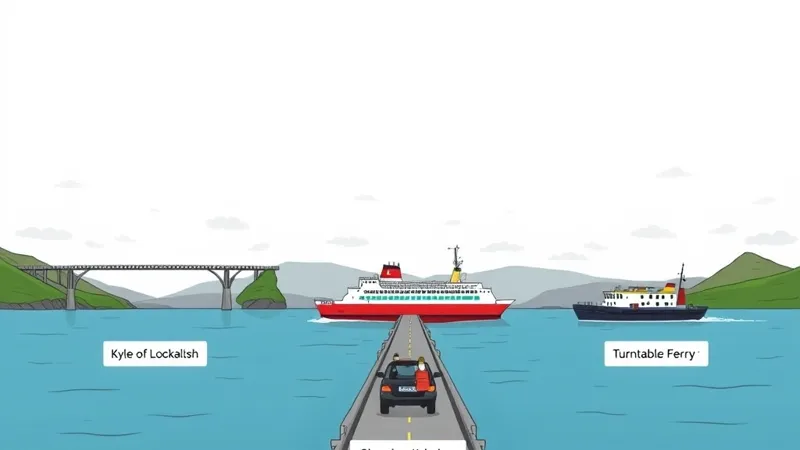
Which route onto Skye should you choose?
Choose the Skye Bridge for an approach through Kyle of Lochalsh without a ferry booking; choose Mallaig–Armadale for a mainland west-coast approach; consider Glenelg–Kylerhea only after checking its seasonal operation. The bridge connects Kyle of Lochalsh with Kyleakin, while the ferries deliver you to different parts of Skye.
The best option depends on your mainland approach, onward destination, transport mode and current conditions. Weather can disrupt access by any route and obscure views. If Portree is your base, plan the whole journey rather than treating the crossing as the finish.
Here is the practical comparison:
- Skye Bridge: Kyle of Lochalsh–Kyleakin; road crossing, not seasonal ferry service; no ferry booking. Without a car, consider through coaches or separately checked onward transport. Status: Traffic Scotland.
- Armadale ferry: Mallaig–Armadale; ferry with date-dependent timetables. Check CalMac booking guidance for vehicles and foot passengers; onward transport matters for both.
- Glenelg crossing: Glenelg–Kylerhea; seasonal ferry. Confirm booking and payment arrangements with the operator. Foot passengers need a workable plan for reaching and leaving the terminals.
When is the Skye Bridge most practical?
The bridge is usually the simplest crossing when your mainland route already leads through Kyle of Lochalsh. You avoid organising your arrival around a sailing, but that does not make the road weatherproof.
Check Traffic Scotland for trunk-road incidents and restrictions before departure. Crossing into Kyleakin is not arriving in Portree: your onward road journey or public-transport connection still needs planning.
For unfamiliar-road preparation, the Highway Code requires keeping left and explains single-track passing places: use one on your left, or wait opposite one on your right; passing places are not parking spaces. Review these arrangements before driving beyond the main roads.
How do you plan the Mallaig–Armadale ferry?
Plan the CalMac crossing around your actual travel date, passenger type and onward destination. Use CalMac for the relevant route timetable, booking instructions, check-in requirements, accessibility information and service-status notices.
Vehicle travellers should check space for their vehicle and any applicable dimensions before committing to the mainland itinerary. Foot passengers should check their own reservation and check-in requirements rather than borrowing the vehicle instructions. Neither a timetable nor a search result guarantees available space.
Armadale is your arrival point on southern Skye, not Portree. Match any proposed sailing to a separately checked bus or prearranged transfer. Leave room for disembarkation and finding the correct departure point; do not assume that a bus waits for the ferry.
Recheck CalMac notices before travelling to Mallaig, especially when the crossing anchors an overnight booking.
How does the seasonal Glenelg–Kylerhea ferry work?
Glenelg–Kylerhea is a seasonal alternative with a distinctive turntable ferry, not an automatic shortcut. Its narrow approach roads and single-track sections make it a different driving decision from using the bridge.
Consult the Glenelg ferry operator for the operating season, hours, booking policy, payment arrangements, vehicle suitability and accessibility. Confirm operation before committing to the approach, particularly if your vehicle or mobility needs require specific arrangements.
The turntable is part of the ferry's loading arrangement, but suitability should never be inferred from photographs alone. Allow flexibility rather than assuming a particular wait, and do not build the choice around promised wildlife sightings.
For foot passengers, the crucial question is whether transport works on both sides of the water.
Which crossing works from Edinburgh or Inverness?
Choose the mainland approach first, then check whether the crossing fits your complete itinerary. The bridge means approaching through Kyle of Lochalsh; Armadale means reaching Mallaig; Glenelg requires a separately planned approach when operating.
From Edinburgh, compare a route towards Inverness and Kyle of Lochalsh with a west-coast itinerary towards Fort William and Mallaig. For coach travel to Portree, plan a change via Glasgow or Inverness rather than expecting a direct Edinburgh service.
From Inverness, compare a through coach towards Portree with rail to Kyle of Lochalsh followed by onward transport. Mallaig and Glenelg involve different route structures, not interchangeable final stops.
Use ScotRail for scheduled trains, Scottish Citylink for coaches and Traveline Scotland for connecting services on your travel date. Ordinary scheduled trains are not the Jacobite steam train: do not assume the latter operates that day or has seats available.
Can you continue to Portree without a car?
Yes, but a crossing is useful only when the onward transport also works. A through coach via the bridge can remove a transfer that would otherwise be needed after a train or ferry.
For rail to Kyle of Lochalsh, check the onward departure point and service to your destination. For rail to Mallaig, check both the train-to-ferry connection and the Armadale-to-Portree journey independently through Traveline Scotland and the relevant operators.
Before choosing Glenelg as a foot passenger, establish how you will reach Glenelg and leave Kylerhea. Do not assume either landing has a convenient onward service.
Check luggage allowances, mobility assistance, last departures and accommodation check-in arrangements. Ask each operator about accessibility: a suitable train does not make every later transfer accessible. Our getting-there guide helps frame the wider journey.
What should you do if weather disrupts your crossing?
Check the whole route before replacing a cancelled ferry with another crossing. Use this sequence:
- Check your ferry operator's service-status information.
- Check Traffic Scotland restrictions and Met Office forecasts and warnings.
- Reassess onward buses, booked transfers and accommodation arrival arrangements.
- Change route only once the alternative is workable, including its approaches.
The bridge is not a guaranteed fallback during severe weather. Switching from Mallaig or Glenelg can require a substantially different itinerary, and another ferry may also be affected.
Make decisions using the forecast and operational notices for your journey, not general seasonal expectations. A crossing that remains available does not guarantee clear views or that planned sightseeing stops will operate.
How should crossings affect a tour or overnight booking?
Compare advertised transport and disruption arrangements, not just the attraction list. For Edinburgh and Inverness departures, check the stated crossing, overnight location, accommodation inclusions and policy when weather changes the programme.
A day trip limits island time; a multi-day itinerary can spread travel across overnight stays. Neither automatically includes a ferry or a Portree base. Check where you sleep before assuming you can explore Portree after the day's programme.
If the crossing affects your choice, compare day trips and multi-day tours, then examine the Skye tour with accommodation for its advertised arrangements and live GetYourGuide widget.
Isle of Skye Guide is an independent editorial comparison site, not a tour operator. We may earn commission through affiliate bookings. Weather can change stops or replace crossings; accommodation and admissions also deserve attention before booking.
What else should you know about the routes onto Skye?
A ferry is optional, but onward planning is essential whichever crossing you choose.
Is a ferry necessary to reach Skye?
No: the Skye Bridge connects Kyle of Lochalsh with Kyleakin by road. Check Traffic Scotland for restrictions rather than assuming access is uninterrupted.
Does the Armadale ferry arrive in Portree?
No: the Mallaig–Armadale ferry arrives at Armadale, not Portree. Check CalMac arrivals against separately confirmed onward transport to your accommodation.
Does the Glenelg ferry operate year-round?
No: Glenelg–Kylerhea is a seasonal crossing. Consult the operator's current season and operating notices before planning around it.
Do foot passengers need onward transport?
For Portree, foot passengers arriving at Armadale or Kylerhea need a separately planned onward journey. Rail passengers reaching Kyle of Lochalsh likewise need to check how they will continue onto Skye.
Does a ferry ticket include the Jacobite train?
Do not assume a Mallaig–Armadale ferry ticket includes the Jacobite train. Treat them as separate bookings unless a package explicitly includes both, and check the train operator's current availability.
Sources
Use the relevant official source for your travel date before committing to a crossing.
- CalMac: Mallaig–Armadale timetables, bookings, check-in, accessibility and disruption notices.
- Glenelg ferry operator: Glenelg–Kylerhea seasonal operation, vehicle suitability and passenger arrangements.
- Traffic Scotland: trunk-road incidents and restrictions.
- Met Office: local forecasts and weather warnings.
- Highway Code: driving rules and single-track-road guidance.
- ScotRail, Scottish Citylink and Traveline Scotland: date-specific rail, coach and connecting-bus research.
- The Highland Council: local-road notices and relevant local transport information.