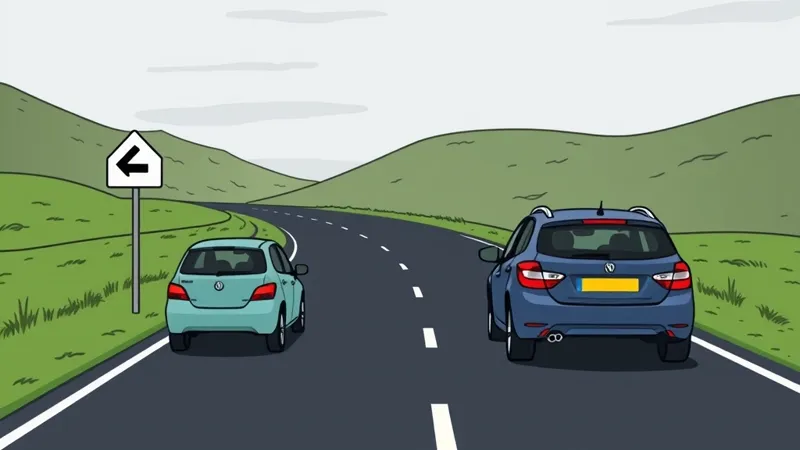
How do you drive on Skye’s single-track roads and keep left?
Keep left on two-way roads; use passing places on single-track sections to meet oncoming traffic and let following vehicles overtake safely. The Highway Code’s using-the-road guidance, including rule 160, explains keeping left. Its single-track guidance, rule 155, says to pull into a passing place on your left or wait opposite one on your right, reversing if necessary to reach a suitable space. It also says not to park in passing places.
A single-track road has a lane shared by traffic travelling in both directions. A passing place is a widened section where vehicles can pass. The verge is the strip beside the road surface, often grass or soft ground—not an extra driving lane.
Look ahead for usable passing places rather than continuing until vehicles meet nose to nose. Leaving room to manoeuvre makes encounters less stressful.
How do passing places work when vehicles meet?
Your position relative to the passing place determines where to wait, not which vehicle is larger. Apply the Highway Code’s country-road and single-track guidance as follows:
- Passing place on your left: pull into it and leave room for the approaching vehicle.
- Passing place on your right: wait opposite it, allowing the approaching vehicle to use it; do not cross over into it.
- Approaching vehicle already waiting: assess the available gap and proceed cautiously only when there is enough room.
- Meeting between passing places: stop rather than squeeze through; a driver may need to reverse carefully to a suitable space.
Under the same guidance, give way to vehicles coming uphill whenever possible and reverse if necessary. These rules do not award automatic priority to the larger vehicle or the first driver to arrive.
If reversing is needed, agree a clear movement rather than both moving at once. If you cannot see the space behind you adequately, stop and reassess.
When should you let vehicles behind you pass?
Use a suitable passing place when following traffic wants to overtake. This is part of Highway Code rule 155, not merely a courtesy to oncoming drivers.
Check mirrors regularly, choose somewhere with enough room and make your intention clear. Avoid accelerating as someone attempts to pass, mounting a soft verge or waving another driver into a manoeuvre whose safety they must judge themselves.
For moving off, the Highway Code’s using-the-road guidance advises effective observations, signalling if necessary and moving only when safe. Check that the overtaking vehicle has cleared your path and that no oncoming traffic is entering the gap.
How can international visitors remember to keep left?
Make a conscious “keep left” reset whenever you restart or change direction. Driving on Skye for overseas visitors can feel most unfamiliar after a quiet stop, when there is no traffic to follow.
Use this practical checklist alongside the Highway Code’s junction, roundabout and positioning guidance:
- Leaving a car park: identify the left-hand side of the road before pulling out.
- Returning after a stop: pause, orient yourself and check both directions.
- Turning at a junction: finish the turn on the correct side, following signs and markings.
- Entering a roundabout: follow lane markings and give priority to traffic approaching from the right unless signs, markings or signals direct otherwise.
Keeping left on a two-way road does not mean driving along the verge of a single-track road. On the shared lane, position the vehicle safely and use passing places to resolve encounters.
How should you approach bends, cyclists, livestock and larger vehicles?
Choose a speed that allows you to stop within the road you can see to be clear, as advised by the Highway Code’s general driving guidance. On blind bends and narrow shared sections, allow extra margin because approaching traffic also needs room to stop.
The Highway Code’s chapter “Road users requiring extra care” supports giving vulnerable road users time and space. Wait for adequate room rather than squeezing past cyclists, pedestrians or horses. Avoid pressuring them towards an unstable verge.
Expect livestock near farmland and remain alert for animals entering the road. For coaches and campervans, consider width, mirrors and turning space: a gap that accommodates a small car may not accommodate a larger vehicle. Waiting farther back can leave everyone more room.
Where can you park without blocking a passing place?
Use designated parking rather than a passing place. Highway Code rule 155 expressly says not to park in passing places; a photograph is not a reason to treat one as parking.
A lay-by is not automatically unrestricted parking, and a private entrance is not a public stopping area. Read the signs and consult Highland Council’s parking information for the relevant location.
For a photo stop, choose somewhere that leaves the road, emergency access and turning areas unobstructed. If a marked car park is full, consider another stop rather than improvising on roadside ground. Passengers getting out also need somewhere suitable to stand.
How do weather and road closures affect a Skye driving itinerary?
Weather can remove stops from your plan, not simply make the drive slower. Wind, rain, snow, ice and poor visibility can affect road access, including the Quiraing road. No viewpoint or attraction should be treated as guaranteed.
Check Met Office weather warnings for forecast hazards. Use Traffic Scotland for trunk-road disruption and Highland Council for local-road notices; the services cover different parts of the network.
Follow closure instructions published by the responsible road authority and displayed on site. A navigation app offering a route is not evidence that the road is open or safe. Build flexibility into accommodation and sightseeing decisions, and be willing to abandon a stop rather than seek an unsuitable shortcut.
How can you decide whether to drive on Skye or visit without a car?
Driving is a better fit when you are comfortable with the vehicle and willing to change plans. Ask yourself:
- Can I reliably keep left after stops and at junctions?
- Can I reverse carefully on a narrow road?
- Am I comfortable judging this vehicle’s width?
- Will I turn back or skip a stop when conditions require it?
If not, start with our guide to reaching Skye without a car and Portree accommodation guide. Research public transport through Traveline Scotland, then confirm connections with operator timetables; reaching Skye does not mean every rural attraction is conveniently accessible.
For an alternative to driving, compare Skye tours from Edinburgh or consider the Inverness day-trip option. Isle of Skye Guide is an independent affiliate guide, not a tour operator. Tour prices and ratings belong in live GetYourGuide widgets on the linked pages. Check inclusions: admissions may be additional, and weather can alter stops.
What else should visitors know about driving on Skye?
Passing places manage traffic; they do not make every road suitable for every vehicle.
Are all Skye roads single-track, and is a campervan suitable for every road?
No. Skye also has roads with separate lanes for opposing traffic. Campervan suitability depends on width, manoeuvring space, conditions and restrictions. Permission to enter a road does not establish that it suits your vehicle or experience.
Can I use a passing place on my right?
Highway Code rule 155 says to wait opposite a passing place on your right so the approaching vehicle can use it.
Who reverses if cars meet?
Highway Code rule 155 advises giving way uphill whenever possible and reversing if necessary to reach a passing place. It does not automatically assign reversing to the smaller vehicle.
Can I stop in a passing place for a photograph?
Do not use it as a photo-stop parking space: Highway Code rule 155 says not to park there. Use suitable designated parking instead.
Must I let following vehicles pass?
Highway Code rule 155 says you should use passing places to let following traffic overtake. This is advisory wording, not a separately stated legal MUST requirement; do not enable an unsafe manoeuvre.
Sources
These official references support the guidance and provide places to check changing conditions; they have not been live-verified for this article. No editorial review date is claimed.
- Highway Code: general rules and advice: country-road guidance and rule 155 cover country roads and single-track conduct. “Should” is advisory; legal requirements are identified by MUST or MUST NOT and legislation references.
- Highway Code: using the road: keeping left, moving off, junctions and roundabouts.
- Highland Council: location-specific parking information and local-road notices requiring current checks.
- Traffic Scotland: trunk-road incidents, restrictions and disruption.
- Met Office weather warnings: weather hazards to reassess before travel.