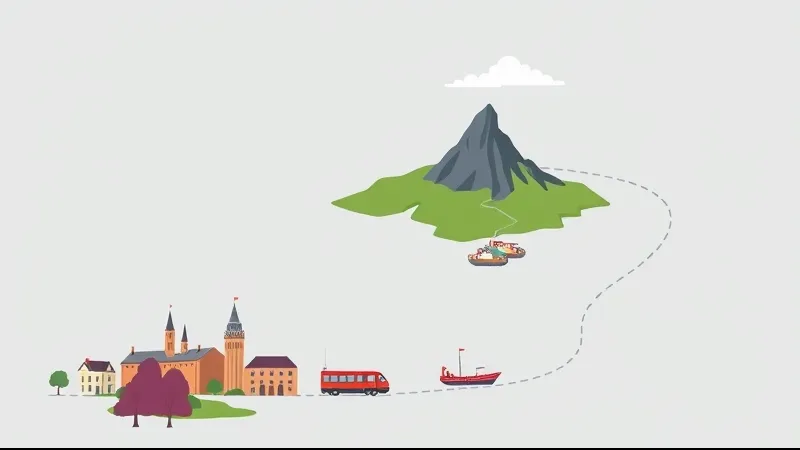
Edinburgh or Inverness: which base actually works better for reaching Skye?
Inverness is the shorter and simpler approach. It is the only one of the two cities with a rail line running towards Skye — ScotRail's Kyle Line to Kyle of Lochalsh, on the mainland side of the Skye Bridge — and the only one with a direct Scottish Citylink coach through to Portree. If Skye is the reason for the trip and you are travelling without a car, Inverness wins on simplicity.
Edinburgh is the better base when Skye is one part of a wider Scotland trip, when you are flying into or out of Edinburgh Airport, or when you want the West Highland Line and the Caledonian MacBrayne Mallaig–Armadale ferry approach rather than the northern one. There is no direct coach from Edinburgh to Portree at all: every option needs at least two legs, via Glasgow or via Inverness.
A day trip from Edinburgh is a very long day with a small number of roadside stops. A day trip from Inverness is feasible but still tight. Three to five days based on the island — Portree is the usual base, a town of 2,281 people at the 2022 census — is what lets a weather-dependent itinerary breathe.
The decision rule the rest of this article expands: pick Inverness for access, Edinburgh for a wider trip, and Skye itself if you intend to walk.
What are the actual public transport routes from each city to Skye?
Every scheduled option below is quoted only as published by ScotRail, Scottish Citylink and CalMac. No driving distances or drive times appear anywhere in this article, because no official source publishes them for these routes — the figures circulating online come from blogs, not operators. Re-verify every figure below on the operator's own page before you travel, and at each translation of this page.
From Inverness
- ScotRail, Inverness to Kyle of Lochalsh (the Kyle Line): 2h38–2h41, and only three services a day — ScotRail timetables.
- Scottish Citylink coach, Inverness to Portree: 3h12–3h20, with four services a day in summer — Scottish Citylink.
- Onward on the island, Portree to Uig by coach: 27 minutes.
From Edinburgh
- Rail to Inverness, then the Kyle Line: fastest direct Edinburgh–Inverness 3h29, with six direct services a day Monday to Friday, then 2h38–2h41 onward.
- Rail via Glasgow onto the West Highland Line: Glasgow to Fort William 3h46–3h47, Fort William to Mallaig 1h22–1h25, then the CalMac ferry.
- CalMac Mallaig–Armadale: crossing 30 minutes, six sailings a day from Mallaig in summer and two in winter, summer timetable 27 March – 18 October 2026. CalMac states that "Booking is essential on this route". Check-in is 20 minutes before departure for vehicles and 10 minutes for foot passengers. Fares: adult £4.00 single / £8.00 return, child 5–15 £2.00 / £4.00, car £13.25 / £26.50 — CalMac.
- Coach: there is no direct Edinburgh–Portree coach. Glasgow to Portree is 6h25; Fort William to Portree is 3h05; Glasgow to Inverness by rail is 3h17.
Our getting there page keeps the same figures in one place.
How does the Kyle Line from Inverness compare with the West Highland Line from Edinburgh?
The Kyle Line ends closer to Skye. Kyle of Lochalsh sits opposite Kyleakin at the Skye Bridge, whose tolls were revoked in 2005, so the bridge itself is free and the crossing is a road link rather than a booking. Mallaig, the end of the West Highland Line, requires the CalMac crossing to Armadale in the south of the island — a further leg, a further timetable, and a sailing that wind can cancel.
Frequency is the other planning difference. The Kyle Line runs only three services a day, so a missed connection at Inverness can mean a lost day rather than an hour's wait. The West Highland Line adds a ferry to the same problem: miss the train at Fort William and you may also miss the last useful sailing, since Mallaig has six departures a day in summer and two in winter.
Whether a bus meets a given train at Kyle of Lochalsh or at Armadale is worth checking on the Citylink timetable for your exact date rather than assumed.
Both lines are described as scenic. Low cloud and rain are common on this coast, and no view is promised on either.
Does the Jacobite steam train change the answer?
No — it is an optional extra, not a way of reaching Skye. The Fort William–Mallaig steam service is operated by West Coast Railways, ticketed separately, and does not run all year: the operator publishes a morning service from 1 June to 23 October 2026 and an afternoon service from 10 June to 25 September 2026, with dates and availability on its own page.
Never build an itinerary that fails without a seat. West Coast Railways states that seats on the day of travel "can never be guaranteed" and that "There are not many seats". The steam traction is not guaranteed either: in extreme heat the service can be suspended, and at times of high fire risk or locomotive trouble the train may be hauled by a heritage diesel. Engineering and weather can cancel it outright.
The regular ScotRail service covers the same Fort William–Mallaig section year-round in 1h22–1h25. Adult standard return on the steam service is £76.00, described by the operator as correct at time of publication and subject to change — check West Coast Railways before budgeting. If the steam train matters to you, our 4-day Skye and Jacobite steam train page explains how the two fit together.
Is a day trip to Skye from Edinburgh worth it?
Only if you have a single free day, no intention of walking, and you accept that most of that day is spent travelling. The format is an early start and a late return, with a small number of roadside stops rather than time on the island.
Stop lists on any day trip are indicative, not contractual. Operators drop or swap stops for weather, road closures or timing, and that is normal rather than a failure — the Quiraing road (the C1225) is closed overnight in winter for snow and ice pending treatment, and Dunvegan can close at short notice in high winds.
If you want time on Skye rather than a long look at it, the multi-day formats are the honest answer. Compare them side by side on our day trip vs multi-day tour page. No prices or ratings appear in this text; the live figures are in the GetYourGuide widgets on each tour page.
Is a day trip to Skye from Inverness a realistic option?
Yes, with limits. Inverness is the closer starting point and a same-day return is a common tour format there, but it is still a long day and typically covers the Trotternish side — Storr, Kilt Rock, sometimes the Quiraing viewpoint — rather than the whole island.
The same substitution rules apply. Dunvegan Castle and Gardens can close castle and gardens at short notice in high winds, and the Quiraing road can close in snow or ice. A single-day format gives no margin to reschedule around weather, so a poor forecast simply becomes the day you get.
It is the sensible choice for travellers already based in Inverness for other reasons — see, for example, the Skye and Eilean Donan day trip from Inverness.
When does a 3 to 5 day tour make more sense than a day trip?
When the weather has to be planned around rather than hoped for. A weather-dependent island rewards spare days, and sleeping on Skye removes the daily long-distance travel entirely.
Broadly, and subject to change on any given departure: 3-day formats concentrate on Skye's main north, with one or two Highland stops en route; 4-day formats add either a slower pace or an extra element such as the steam train; 5-day formats spread the driving across more of the Highlands and leave more room to reorder a day. Multi-day tours from Edinburgh usually pass through more of the Highlands on the way, while those from Inverness reach Skye sooner.
No stop on any of these is guaranteed. For a like-for-like view of the Edinburgh departures, see our comparison of 3-day Skye tours from Edinburgh.
What does the weather record actually say about planning from either base?
Overcast is the statistical norm on Skye, not bad luck. Met Office 1991–2020 averages give Prabost, near Portree, 1,769.05 mm of rain a year against 755.02 mm at Inverness — well over twice as much on the island. The wettest month at Prabost is January with 208.52 mm (December 202.66, November 204.58, October 198.64); the driest is June with 82.15 mm (May 90.10, April 94.66). July still records 102.38 mm and August 124.89 mm.
Sunshine averages 1,200.34 hours a year, best in May at 195.83 hours and worst in December at 30.72. Mean temperatures are mild rather than warm: August maximum 17.09 °C and minimum 10.50 °C, July maximum 16.93 °C, January maximum 6.64 °C and minimum 1.94 °C, annual mean maximum 11.70 °C. Western and northern parts of northern Scotland are on average the windiest of the UK, strongest from December to February, and snow falls on fewer than 30 days a year on the west coast, normally November to April.
Daylight swings hard: at Portree, 21 June 2026 runs from a 03:26 sunrise to a 21:27 sunset — 18 hours and 1 minute — while 21 December gives 09:05 to 15:41, just 6 hours 36.
The operational point: an itinerary that depends on a clear view of the Cuillin or the Storr is an itinerary likely to disappoint. And the drier east-coast base tells you nothing about the weather on the island — Inverness being dry on the morning you leave does not make Skye dry when you arrive. Edinburgh's own averages are published on the Met Office UK climate averages pages; this article quotes only the Prabost and Inverness figures it has verified.
Which walks can you realistically fit from each base, and how hard are they?
A day trip realistically allows one short walk at most. These are not all easy walks.
- Old Man of Storr — 3.8 km. The site manager advises allowing at least 2 hours return and describes the path as "steep and exposed": gravel, then steep uneven rock steps, with a permanent danger of rockfall higher up.
- Quiraing circuit — a 6.8 km loop of about 2 hours, classified Medium for length but Hard for difficulty by Walkhighlands, with steep grassy slopes, mud, scree and long stretches very close to the cliff edge. It is "not suitable in all weather conditions".
- Fairy Pools — 2.4 km return, 40 minutes to 1 hour 30, about 20 minutes to the first waterfall; Short for length, Medium for difficulty. Stones get slippery when wet and the water is rarely warm.
- Neist Point — 2.2 km, about 45 minutes, on a concrete path that is very steep in places with a demanding climb back near the cliffs. The Northern Lighthouse Board states there is no public access to the tower.
- The Cuillin — not a hike. Sgurr Alasdair reaches 992 m, the Black Cuillin ridge runs over 11 km with 11 Munros, and the iron in the rock can make a compass read wrong. The destination body explicitly recommends going with a guide. Note also that no avalanche forecast covers Skye: the Scottish service (SAIS) covers six areas and the Cuillin are not among them.
Footwear, wind and daylight decide feasibility more than fitness alone. Midges are a summer factor rather than a safety one — they peak in July and August, are worst at dawn and dusk, and cannot fly in wind above 8.8 km/h (5.5 mph).
What will you pay in pounds once you are on the island?
These are fixed, verifiable costs that sit on top of any tour or fare, and they usually apply whether or not you complete the walk. Parking is limited and fills early in summer.
- Old Man of Storr car park: £6.00 up to 6 hours, £8.00 up to 12 hours (both raised by £1.00 on 1 April 2026), 140 vehicle capacity, free toilets.
- Quiraing car park: £3.00 up to 3 hours, £6.00 up to 6 hours, 40 spaces.
- Fairy Pools: access is free, you pay only for parking — motorcycle £4.00, car £8.00, campervan £10.00, tour minibus £20.00, 177 spaces. About 240,000 people a year visit, the only verified visitor count on the island.
- Dunvegan Castle and Gardens: adult £17.50, child 5–15 £12.00, students and over-65 £15.00, family £45.00, gardens only £15.50; open 1 April – 15 October, 10:00–17:30. The estate may close castle and gardens at short notice in high winds. Until 1 September 2026 the 15% discount applies only at the ticket office and e-tickets are not sold. Check Dunvegan Castle before visiting.
- Eilean Donan, on the mainland approach: adult £13.00, concession £12.00, child 5–15 £5.75, family £33.25, under 5 free. Eilean Donan Castle states that tickets "can only be purchased on site, on the day of visit", so there is no online booking, and that large backpacks are not allowed inside.
VAT on attraction tickets was cut from 20% to 5% between 25 June and 1 September 2026, so check every admission on the attraction's own site before you go. Organised tours cover site entry differently: check what a given tour includes on its own page.
Which base suits your trip? A decision checklist
- Choose Inverness if Skye is the main goal. It is the closer starting point and the shortest scheduled journey.
- Choose Inverness if you are travelling without a car. It has the only rail line towards Skye and a direct coach to Portree.
- Choose Inverness if your time is short. A same-day return is realistic there, if tight.
- Choose Edinburgh if you are already there. Going north to Inverness first is a normal part of the plan, not a mistake.
- Choose Edinburgh if Skye is one stop in a wider Highlands trip. The multi-day routes from Edinburgh pass through more of the mainland.
- Choose Edinburgh if you are flying via Edinburgh Airport. Backtracking to the airport from Inverness costs a day.
- Choose Edinburgh if you want the West Highland Line and the Mallaig–Armadale ferry. That approach only exists from the south.
- Choose to sleep on Skye itself if you intend to walk. Portree is the usual base, and walking needs the morning, not the leftovers of a travel day.
What can go wrong on either route, and how do you build slack into the plan?
The recurring disruptions are known and mostly weather-driven. Ferry sailings are cancelled for wind. The Quiraing road (C1225) is closed overnight in winter for snow and ice pending treatment, and Highland Council treats priority 1 routes 06:00–21:00, priority 2 06:00–18:00 and minor rural roads "as resources allow", with no overnight service. Dunvegan closes in high winds. Single-track roads slow down in poor weather — the Highway Code (rule 155) says to pull into the passing place on your left, or wait opposite one on your right, and passing places are not parking spaces. Traffic Scotland warns to expect livestock near farms and deer on country roads, and not to swerve for a deer. Missed rail connections hurt because there are few later services, and timetables are reduced outside summer.
The practical response: check the operator's live service page the evening before and the morning of travel — CalMac service status, Traffic Scotland and ScotRail service updates — keep one flexible day in the plan, and do not book anything unrecoverable on the last day before a flight.
Frequently asked questions
Can you reach Skye without a car?
Yes. From Inverness there is a direct Scottish Citylink coach to Portree, and ScotRail's Kyle Line reaches Kyle of Lochalsh at the mainland end of the Skye Bridge. From Edinburgh you need at least two legs, via Glasgow or via Inverness. Check current times and frequencies on the ScotRail and Citylink pages before travelling.
Is there a train to the Isle of Skye itself?
No. No railway runs onto the island. The nearest stations are Kyle of Lochalsh, opposite Kyleakin at the Skye Bridge, and Mallaig, from which the CalMac ferry crosses to Armadale in the south of Skye. Onward travel from either is by bus, ferry or road. See ScotRail and CalMac for current services.
Is Inverness closer to Skye than Edinburgh?
Yes, on every published scheduled journey. This site quotes no driving distances or drive times because no official source publishes them for these routes. What is published is clear enough: the Inverness–Portree coach and the Inverness–Kyle of Lochalsh train are both far shorter than any Edinburgh option, none of which is direct.
How many days do you need on Skye?
Three to five days is the range that lets weather be planned around rather than hoped for. One day gives you the road and a couple of viewpoints. Sleeping on the island, usually in Portree, removes the daily long-distance travel and means a bad morning can be swapped for a better afternoon.
Can you do Skye and the Jacobite steam train in the same trip?
Yes, but treat the steam train as a bookable extra rather than a fixed point. It runs seasonally between Fort William and Mallaig, is ticketed separately by West Coast Railways, and the operator states that day-of-travel seats can never be guaranteed. The regular ScotRail service covers the same section year-round.
Is the Old Man of Storr walk suitable for beginners?
It is short but not easy. The route is 3.8 km, the site manager advises allowing at least 2 hours return and describes the path as steep and exposed, with gravel then steep uneven rock steps and a permanent danger of rockfall higher up. Fit walkers in proper footwear manage it; wind and wet rock decide the rest.
Do you have to pay to park at the main sites?
Yes, at the main Trotternish and Glen Brittle sites. Charges apply at the Old Man of Storr, Quiraing and Fairy Pools car parks whether or not you complete the walk, and access to the Fairy Pools themselves is free. Spaces are limited and fill early in summer. Current tariffs are on each car park operator's own page.
Which base is better in winter?
Inverness, because the journey is shorter and there are fewer connections to lose. Winter brings reduced timetables, fewer ferry sailings, short daylight and a Quiraing road that closes overnight for snow and ice. Note also that no avalanche forecast covers the Cuillin. Check live service pages the evening before and the morning of travel.
Sources
Every figure in this article traces back to one of the sources below. Tour prices and ratings are never cited here: they come only from the GetYourGuide widgets on the tour pages. All links checked 3 August 2026.
- ScotRail — Inverness–Kyle of Lochalsh and West Highland Line timetables, service updates
- Caledonian MacBrayne (CalMac) — Mallaig–Armadale timetable and fares; live service status
- Scottish Citylink — Inverness–Portree and Glasgow–Fort William coach services
- West Coast Railways — Jacobite operating dates, fares and seat availability statements
- Met Office UK climate averages — 1991–2020 rainfall, sunshine and temperature figures
- Walkhighlands — route lengths and difficulty grades
- The Storr — path description, parking charges and capacity
- NatureScot — path and access information
- The Highland Council — car park charges, winter road treatment and closures
- Traffic Scotland — live road status and rural road advice
- The Highway Code — rules 155 and 160 on single-track roads
- Dunvegan Castle and Gardens — admission in pounds and opening dates
- Eilean Donan Castle — admission in pounds, on-site ticketing and entry conditions
- Historic Environment Scotland — mainland sites near the Kyle of Lochalsh approach
- Scottish Avalanche Information Service (SAIS) — forecast area coverage
- VisitScotland — general destination guidance