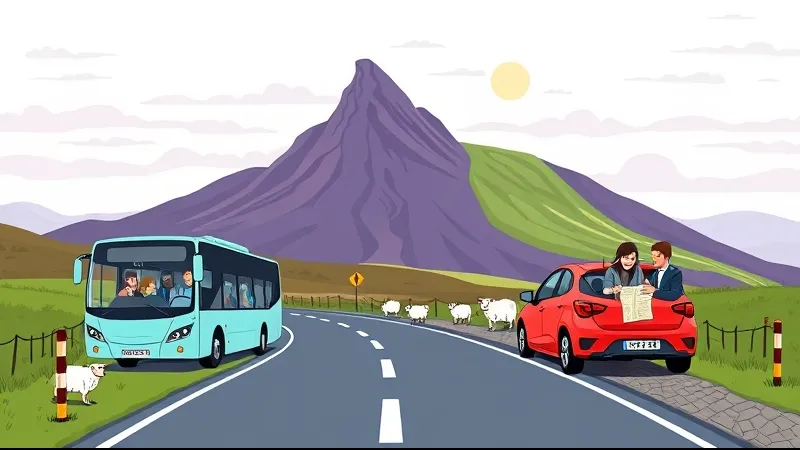
Guided Tour or Self-Drive on Skye: Which One Fits Your Trip?
A guided tour fits you if you have no car, no experience of driving in the UK, only a single day from Edinburgh or Inverness, or no appetite for single-track roads in rain and low cloud. Self-drive fits you if you are staying three nights or more on the island and want to move stops around when the forecast changes.
What neither option can do is more important than what separates them. No tour and no hire car changes the weather, the road status or the ferry service. Both are affected by exactly the same closures: the Quiraing road can be shut by snow, ice or landslip, Dunvegan Castle can close at short notice in high winds, and ferries cancel in swell. An overcast day on Skye is the statistical norm, not bad luck.
The decision rule: if Skye is one day inside a wider Scotland trip, take the tour; if you are sleeping on the island for three nights or more, take the car. Everything below is the detail behind that line — jump to the side-by-side comparison if you want the short version.
What Does a Guided Skye Tour Actually Include, and What Does It Not?
An organised Skye tour includes transport, a driver-guide, a fixed departure point in Edinburgh or Inverness, and a published stop list that the operator reserves the right to alter. At each stop you get free time rather than led walking — the guide drives, narrates and sets the timings, but does not usually walk you up a mountain path.
What is normally not included: admissions to castles and attractions, meals, and any rail segment. Stop lists are indicative, not contractual. No operator controls the weather, the road status or the ferries, so a re-route is a normal event rather than a failure.
Because inclusions, duration and departure points change, this article does not quote them. Check the GetYourGuide widget on each tour page for the live details — that is where the current departure time, duration, inclusions and starting price are verified.
How Do You Reach Skye Without a Car?
You can reach Skye without a car, but the itinerary has to be built around the timetable rather than the other way round. The realistic legs, all from official timetables:
- Train, ScotRail: Inverness–Kyle of Lochalsh takes 2h38–2h41, with only three services a day. On the West Highland Line, Glasgow–Fort William is 3h46–3h47 and Fort William–Mallaig 1h22–1h25. Edinburgh–Inverness is 3h29 on the fastest direct, with six directs a day Monday to Friday.
- Ferry, Caledonian MacBrayne: Mallaig–Armadale crosses in 30 minutes, with six sailings a day from Mallaig in summer and two in winter (summer timetable 27 March – 18 October 2026). CalMac states that "Booking is essential on this route"; check-in is 20 minutes before departure for vehicles and 10 for foot passengers. Adult fares are £4.00 single and £8.00 return, child 5–15 £2.00 and £4.00, car £13.25 and £26.50.
- Glenelg–Kylerhea turntable ferry: the community service runs "from April until mid-October", seven days a week from 10:00 to 18:00, every 20 minutes or on demand, with a crossing "no longer than fifteen minutes". No advance ticket is needed — you pay on board by cash or card: car with up to four passengers £20.00 (£30.00 return), motorcycle £10.00, foot passenger £5.00, bike with rider £6.00. Bad weather can stop the service.
- Coach, Scottish Citylink: there is no direct coach from Edinburgh to Portree — you need at least two legs via Glasgow or Inverness. Glasgow–Portree is 6h25, Inverness–Portree 3h12–3h20 with four services a day in summer, Fort William–Portree 3h05, and Portree–Uig 27 minutes.
- Local buses, Stagecoach Highlands: these link Portree with the main villages, but frequency is low and Sunday services differ from weekdays.
Pull every departure from the current ScotRail, CalMac, Citylink and Stagecoach timetables before you commit to anything. Our getting there guide sets out the combinations that actually connect.
Is the Jacobite Steam Train a Reliable Part of a Skye Trip?
No. The Jacobite is a separately ticketed seasonal service on the Fort William–Mallaig line, run by West Coast Railways, and it is not part of a standard Skye tour. The operator itself writes that seats on the day of travel "can never be guaranteed" and that "There are not many seats". The steam is not guaranteed either: in extreme heat the service can be suspended, and at times of high fire risk or locomotive trouble the train may be hauled by a heritage diesel.
The morning service runs 1 June – 23 October 2026 (Fort William 10:15, Mallaig 12:25, return 14:10–16:03) and the afternoon service 10 June – 25 September 2026 (12:50–15:06, return 17:00–18:52). Adult standard return is £76.00, first class £116.00, child standard £43.00, with a booking fee from £3.75 and a £15.00 admin fee per change — the operator notes these were "correct at time of publication (December 2025) and are subject to change", so check the Jacobite booking page before you plan around them.
The dependable alternative is the scheduled ScotRail service on the same line: it crosses the Glenfinnan viaduct — 21 arches, over 30 metres above the valley floor, completed in 1901 — year-round, at ordinary fares, with Fort William–Mallaig timed at 1h22–1h25.
What Is Driving on Skye Really Like?
Driving on Skye is straightforward on the main roads and demanding on the rest. Much of the island is single-track with passing places, and the etiquette is set out in Highway Code rule 155: pull into the passing place on your left, or wait opposite one on your right. Passing places are for passing and for letting faster traffic overtake — they are not parking spaces, and both the Highland Council and VisitScotland repeat that point.
Traffic Scotland warns drivers to expect livestock near farms and deer on country roads, and advises not to swerve for a deer. Roads are often unfenced, so sheep on the tarmac are routine rather than remarkable. Fuel stations are limited and the gaps between them are long, so fill up in the larger villages rather than assuming the next one is close.
For international visitors, Highway Code rule 160 — keep left — applies from the moment you leave the rental desk. Note also that the Skye Bridge is free: its tolls were revoked in 2005. Hire cars are booked months ahead for summer, and most UK fleets are manual, so an automatic has to be requested early.
Where Can You Park on Skye, and What Does It Cost?
The honeypot sites now have managed car parks with charges in pounds and finite capacity — and a full car park is the most common reason a self-drive plan collapses at peak times.
- Old Man of Storr: 140 vehicles of capacity, £6.00 up to 6 hours and £8.00 up to 12 hours (both raised by £1.00 on 1 April 2026), with free toilets.
- Quiraing: 40 spaces, £3.00 up to 3 hours and £6.00 up to 6 hours.
- Fairy Pools: 177 spaces, managed by the Outdoor Access Trust for Scotland — motorcycle £4.00, car £8.00, campervan £10.00. Access to the pools themselves is free; about 240,000 people a year visit, the only verified visitor count on the island.
- Neist Point: no authority publishes a verified charge or capacity for this car park, so we do not quote one. Assume it is small and check on site.
These are pounds sterling and were correct at publication; charges are reviewed periodically, so re-check with the operators — the Storr car park publishes its own tariff, the Quiraing car park is a Highland Council site, and the Fairy Pools tariff comes from the Outdoor Access Trust for Scotland. Verge parking is enforced. The practical workaround is not a clever route: it is arriving early in the morning or late in the day.
How Hard Are the Main Walks on Skye?
Skye walking is not uniformly easy, and assuming otherwise is the single most common planning mistake.
- Old Man of Storr — 3.8 km. The site manager advises allowing at least 2 hours return and describes the path as "steep and exposed": gravel first, then steep uneven rock steps, with a permanent danger of rockfall higher up.
- Quiraing — a 6.8 km loop of about 2 hours, classified Medium for length but Hard for difficulty, with steep grassy slopes, mud, scree and long stretches very close to the cliff edge. It is "not suitable in all weather conditions".
- Fairy Pools — 2.4 km return, 40 minutes to 1 hour 30, about 20 minutes to the first waterfall; Short for length, Medium for difficulty. There are river crossings, the stones get slippery when wet, the water is rarely warm and one of the jumps is about 10 metres.
- The Cuillin — not a hike. Sgurr Alasdair is 992 m, the Black Cuillin ridge runs over 11 km with 11 Munros, and the compass can read wrong because of the iron in the rock. The destination body explicitly recommends going with a guide; the Inaccessible Pinnacle is graded rock climbing and is never a casual objective.
Mountaineering Scotland and Scottish Mountain Rescue both stress the same basics: proper footwear, the ability to navigate when cloud drops, and a willingness to turn back. Note that guided tours give you free time at viewpoints — they do not complete these walks with you.
How Does Skye Weather Change the Plan for Each Option?
Statistically, a grey and wet day is normal. Met Office 1991–2020 averages put Skye (Prabost, near Portree) at 1,769.05 mm of rain a year against 755.02 mm at Inverness. January is the wettest month at 208.52 mm and June the driest at 82.15 mm; August is still a wet month at 124.89 mm. Sunshine totals 1,200.34 hours a year, peaking in May and falling to 30.72 hours in December. August averages a daily maximum of 17.09°C and a minimum of 10.50°C. Western and northern parts of northern Scotland are on average the windiest of the UK, strongest between December and February, while snow falls on fewer than 30 days a year on the west coast, normally November to April. Visibility at the Storr and the Quiraing is frequently nil.
The consequences are concrete. Dunvegan Castle and its gardens (open 1 April – 15 October, 10:00–17:30) may close at short notice in high winds. The Quiraing road, the C1225, is closed overnight in winter for snow and ice pending treatment; the Highland Council treats priority 1 routes 06:00–21:00, priority 2 routes 06:00–18:00 and minor rural roads "as resources allow", with no overnight service. Ferries cancel in swell. And in winter the mountains here have no avalanche forecast at all: the Scottish Avalanche Information Service covers six areas and the Cuillin are not among them.
The two options absorb this differently. A guided tour re-routes around the problem without a refund and the day still happens. Self-drive lets you swap Tuesday's plan for Thursday's — but the road status becomes your responsibility. Either way, check the Met Office mountain forecast, Traffic Scotland and the CalMac service status page on the morning itself.
Which Option Works Better for a One-Day Trip from Edinburgh or Inverness?
On a one-day frame, the guided tour usually wins — mostly because the travel is handled and there is no parking search inside a tight schedule.
Be honest about the geography. There is no direct coach from Edinburgh to Portree; the public-transport route needs at least two legs via Glasgow or Inverness, and Glasgow–Portree alone is 6h25. Inverness sits far closer: Inverness–Portree is 3h12–3h20 by coach, with four services a day in summer. A day from Edinburgh is therefore dominated by travel and delivers a small number of roadside stops, while a day from Inverness can reach the island with usable time left.
Self-drive on the same single day gives you flexibility that the clock rarely lets you use, plus the car park lottery at the Storr and the Quiraing at exactly the hours everyone else arrives. Compare departure times, the published duration on the widget and the number of stops on a typical itinerary rather than any driving estimate — no official source publishes driving times for these routes.
Start with the Skye and Eilean Donan day trip from Inverness or the Skye Explorer day trip with hikes and read the live details on their widgets.
Which Option Works Better for a 3-to-5 Day Trip?
Once you sleep on the island, the balance shifts to self-drive. A base in Portree, Broadford or Dunvegan plus a car lets you reshuffle days around the forecast, start walks before the car parks fill, and reach corners no coach visits.
The hybrid is common and works well: reach Skye by train and coach, then book one guided day for the Cuillin or a boat trip, or hire a car for part of the stay only. That keeps the mountain day in qualified hands and the flexible days in yours.
The real constraint is not transport. Portree has 2,281 inhabitants (2022 census), and its beds book out months ahead in summer — accommodation, not the road, is what usually fixes your dates.
Still weighing the format? Our comparison of the Skye day trip versus a multi-day tour sets the two side by side with the live durations on each tour page.
Guided Tour vs Self-Drive: A Side-by-Side Comparison
| | Guided tour | Self-drive | |---|---|---| | Who it suits | One-day visitors from Edinburgh or Inverness, non-drivers, first-time UK visitors | Travellers staying 3+ nights on the island | | Transport needed | None beyond reaching the departure point | Hire car or own car, plus ferry booking if arriving via Mallaig–Armadale | | Flexibility when weather changes | The operator re-routes; you accept the new order of stops | You swap days and stops yourself around the forecast | | Parking responsibility | None — the operator handles drop-offs | Yours; charges apply at the Storr, Quiraing and Fairy Pools and capacity is finite | | Walking freedom | Free time at each stop, not led walks; long routes are not completed | Any walk you are equipped for, including early starts before car parks fill | | Luggage and stop timing | Fixed timings set by the guide; luggage stays on the coach | You set the timings; luggage moves with you | | Accessibility and mobility | Depends on the vehicle and stop list — check the widget details on the tour page | You choose viewpoints with short access, such as the wheelchair-accessible Kilt Rock platform | | Driving confidence required | None | Comfort with single-track roads, passing places, reversing, keeping left and livestock on the road | | Who handles road or ferry disruption | The operator | You, using Traffic Scotland and CalMac status pages |
Live cost and duration are not listed here on purpose: they change. Both appear on the GetYourGuide widget of each tour page.
Who Should Not Self-Drive on Skye?
This is a question of fit, not of danger. Self-drive is a poor match if you are:
- a visitor with no experience of driving on the left;
- uncomfortable reversing a car you do not know along a single-track road to reach a passing place;
- arriving straight off a long-haul flight and driving the same day;
- travelling in a group where only one person can drive across a long day;
- visiting in winter without experience of untreated rural roads in ice — remembering that minor rural roads are treated "as resources allow" and not overnight.
Visiting drivers should check the rules for driving on a non-GB licence and read the Highway Code, particularly rules 155 and 160, before collecting a car.
How Do You Book the Option You Have Chosen?
Book in the order that avoids dead ends. First fix the fixed thing: your accommodation, or the tour date. Second, arrange transport to the departure point — trains and coaches on these routes are infrequent, so the connection has to exist before the plan does. Third, add anything with limited capacity: a boat trip, a castle admission, a ferry crossing where CalMac says "Booking is essential".
The free-cancellation window and the exact departure point are shown on the GetYourGuide widget on each tour page — check them there rather than assuming. And be aware that hire cars and Portree beds are the two items that disappear earliest for summer dates.
Frequently Asked Questions
Can you see Skye in one day?
You can reach the island and see a small number of headline viewpoints in one day, particularly from Inverness, which is much closer than Edinburgh. From Edinburgh the day is dominated by travel. Treat a single day as an introduction to a few roadside stops, not as coverage of the island.
Do you need a car on the Isle of Skye?
No, but a car-free trip has to be built around the timetable. Citylink coaches reach Portree and Uig, ScotRail serves Kyle of Lochalsh, and Stagecoach runs local routes — though island bus frequency is low and Sunday services differ. For three nights or more, a car or a guided day fills the gaps.
Is the Old Man of Storr walk suitable for beginners?
It is short at 3.8 km, but not gentle. The site manager advises allowing at least 2 hours return and describes the path as "steep and exposed", with gravel giving way to steep uneven rock steps and a permanent risk of rockfall higher up. Fit beginners manage it; casual footwear does not.
What happens on a tour if the Quiraing road is closed?
The operator re-routes to other stops and the day continues without a refund. The C1225 is closed overnight in winter for snow and ice pending treatment, and can also shut for landslip. This is why published stop lists are indicative and no operator promises a specific viewpoint.
Can you get from Portree to the Fairy Pools by bus?
There are Stagecoach services across the island, but frequency on rural routes is low and Sunday timetables differ from weekdays. Check the current Stagecoach Highlands timetable and plan the return leg first — the last bus, not the walk, is what usually decides whether the trip works.
Is the Jacobite steam train included in Skye tours?
No. The Jacobite is a separately ticketed seasonal service on the Fort William–Mallaig line and is never part of a standard Skye tour. The operator states that seats on the day of travel "can never be guaranteed". Scheduled ScotRail trains cross the Glenfinnan viaduct year-round as the dependable alternative.
Sources
All monetary figures in this article are in pounds sterling (£) and were correct at publication. Timetables, charges and opening times change — re-check each source before travelling.
- VisitScotland — passing-place guidance and Cuillin guiding advice
- Met Office UK climate averages — 1991–2020 rainfall, temperature and sunshine figures
- Met Office mountain weather forecast
- ScotRail — Kyle of Lochalsh line, West Highland Line and Edinburgh–Inverness journey times
- Caledonian MacBrayne — Mallaig–Armadale timetable, fares and service status
- Scottish Citylink — coach journey times to Portree and Uig
- Stagecoach Highlands — island bus routes and Sunday services
- The Highland Council — winter road treatment priorities and the Quiraing car park
- Traffic Scotland — livestock and deer guidance, live road status
- The Highway Code — rules 155 and 160
- Driving on a non-GB licence
- The Storr car park — charges, capacity and path description
- Walkhighlands — route grades for the Quiraing, Fairy Pools and Neist Point
- Mountaineering Scotland and Scottish Mountain Rescue — footwear, navigation and turning-back guidance
- Outdoor Access Trust for Scotland — Fairy Pools car park charges and visitor numbers
- National Trust for Scotland — Highland property information
- Dunvegan Castle — opening dates, admissions and weather closures
- NatureScot — Trotternish landslip geology
- West Coast Railways — Jacobite timetable and fares
- Scottish Avalanche Information Service — forecast areas (the Cuillin are not covered)