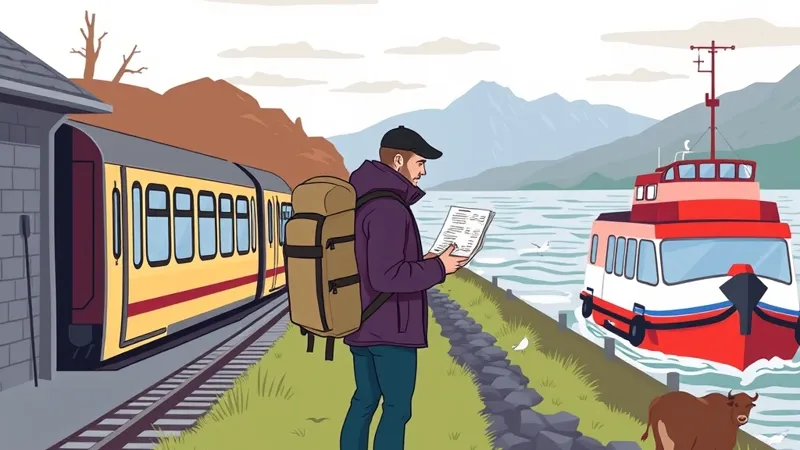
Can you reach the Isle of Skye without a car?
Yes. Skye is connected to the mainland by scheduled rail, coach and ferry services, and since the Skye Bridge opened the island can be reached entirely by road — Transport Scotland, the national transport agency responsible for the trunk road network, records the bridge tolls as removed in 2005, so no ferry crossing is required.
There is no railway station on Skye itself. The two nearest railheads are Kyle of Lochalsh, terminus of the Kyle Line from Inverness and directly across the bridge from Kyleakin, and Mallaig, terminus of the West Highland Line from Glasgow Queen Street via Fort William, linked to Armadale in southern Skye by CalMac ferry. Scottish Citylink coaches run through to Portree and Uig, and the community-run Glenelg–Kylerhea ferry provides a third, seasonal water route.
Set your expectations now. Services are timetabled and infrequent by city standards — the Inverness–Kyle of Lochalsh train runs only three times a day. Every connection must be checked on the operator's own live timetable before you travel, because timetables change seasonally. And weather or road conditions can suspend any leg at short notice: ferries cancel in high wind, and the Quiraing road can close for snow and ice.
Which railway stations are closest to the Isle of Skye?
The two closest stations are Kyle of Lochalsh and Mallaig. Neither is on the island.
Kyle of Lochalsh is the western end of the Kyle Line from Inverness. According to the ScotRail timetable, Inverness–Kyle of Lochalsh takes 2h38–2h41, with only three services a day — so a missed connection is a lost half-day. From Kyle, buses cross the bridge towards Broadford and Portree. This is the natural railhead for anyone heading for central and northern Skye.
Mallaig is the western end of the West Highland Line from Glasgow Queen Street via Fort William. Glasgow–Fort William takes 3h46–3h47 and Fort William–Mallaig 1h22–1h25. From Mallaig the CalMac ferry lands at Armadale, in the Sleat peninsula in southern Skye.
Take journey durations, daily frequencies and Sunday variations from the current ScotRail timetable rather than from any blog, and use Traveline Scotland to plan combined rail-plus-bus journeys in one search.
How do you get from Edinburgh to the Isle of Skye by public transport?
There is no direct coach from Edinburgh to Portree. Every car-free routing needs at least two legs, via Glasgow or via Inverness.
The three realistic shapes are:
- Via Inverness: rail Edinburgh–Inverness, fastest direct 3h29, with six direct trains a day Monday to Friday, then the Citylink coach onward to Portree, or the Kyle Line westward.
- Via Glasgow: rail to Glasgow Queen Street, then either the West Highland Line towards Fort William and Mallaig, or the Citylink coach; Glasgow–Portree by coach is 6h25.
- Via Fort William: the same western corridor, broken overnight at Fort William, which puts Glencoe and Skye on one car-free trip.
Edinburgh to Skye is not a comfortable single-day hop on scheduled services. Most travellers break the journey overnight in Fort William, Inverness or Kyle of Lochalsh — or take a multi-day guided tour instead. Check ScotRail, Scottish Citylink and Traveline Scotland for the dates you travel.
How do you get from Inverness to Skye by bus or train?
Inverness offers the only one-seat public ride to Portree. The Scottish Citylink coach leaves Inverness bus station and runs via Invermoriston and Kyle of Lochalsh to Portree in 3h12–3h20, with four services a day in summer. It books up in peak months, so reserve early.
The alternative is the ScotRail Kyle Line to Kyle of Lochalsh in 2h38–2h41, with only three services a day, followed by a bus over the Skye Bridge. The train is the more scenic option but it ends short of the island, and the onward bus is a separate operator with a separate ticket.
Source first and last departures, frequencies and Sunday service levels from the live Citylink and ScotRail timetables on the day you plan, not from a static list: Scottish timetables are revised twice a year.
How do you get from Glasgow or Fort William to Skye?
The western corridor has two parallel options. Scottish Citylink coaches run from Glasgow Buchanan Street via Fort William to Portree and on to Uig — Glasgow–Portree 6h25, Fort William–Portree 3h05, and Portree–Uig a further 27 minutes. Alternatively, the ScotRail West Highland Line runs Glasgow Queen Street to Mallaig for the Armadale ferry.
Fort William is the natural staging point for anyone combining Glencoe and Skye without a car, and Uig is the through-service terminus for travellers continuing to the Outer Hebrides.
One warning that costs people money: coach, train and ferry are separate operators with no through-ticket guarantee. If one leg runs late, the next operator is under no obligation to hold or rebook you. Build a deliberate buffer between connections rather than the tightest interchange the planner offers.
Which ferries serve the Isle of Skye, and when do they run?
Three water routes matter, and none of them is compulsory: the Skye Bridge carries the road to the island as a toll-free trunk road crossing, as Transport Scotland records, so you can arrive without any sailing at all.
CalMac Mallaig–Armadale is the main link to southern Skye. The crossing takes 30 minutes, with six sailings a day from Mallaig in summer and two in winter; the summer timetable runs 27 March – 18 October 2026. CalMac states that "Booking is essential on this route", with check-in 20 minutes before departure for vehicles and 10 minutes for foot passengers. Fares: adult £4.00 single, £8.00 return; child 5–15 £2.00 / £4.00; car £13.25 / £26.50. Confirm current fares on CalMac's own fare finder before travelling.
CalMac Uig–Tarbert (Harris) and Uig–Lochmaddy (North Uist) carry onward island-hopping traffic from northern Skye.
Glenelg–Kylerhea, the community-run turntable ferry, runs "from April until mid-October", seven days a week 10:00–18:00, every 20 minutes or on demand, with a crossing "no longer than fifteen minutes". No advance ticket is needed — you pay on board by cash or card. Car with up to four passengers £20.00 (£30.00 return), motorcycle £10.00, foot passenger £5.00, bike with rider £6.00. The operator notes bad weather can occasionally stop the service.
Check CalMac's live service status and the Isle of Skye Ferry CIC site for current operating dates.
Can you count on the Jacobite steam train to reach Skye?
No. Treat the Jacobite as an optional experience, never as a transport plan.
It is a privately operated seasonal heritage service on the Fort William–Mallaig line, run by West Coast Railways. The morning service runs 1 June – 23 October 2026 (Fort William 10:15, Mallaig 12:25, return 14:10–16:03) and the afternoon service 10 June – 25 September 2026 (12:50–15:06, return 17:00–18:52). Adult standard return £76.00, first class £116.00, child standard £43.00, private table for two £252.00, booking fee from £3.75 and a £15.00 admin fee per change — prices "correct at time of publication (December 2025) and are subject to change".
The operator is blunt that day-of-travel seats "can never be guaranteed" and that "There are not many seats". Even the steam is conditional: in extreme heat the service can be suspended, and in high fire risk or with locomotive trouble the train may be hauled by a heritage diesel.
The dependable alternative crosses the same Glenfinnan Viaduct — 21 arches, over 30 metres above the valley floor, completed in 1901 — on a normal ScotRail ticket.
How do you travel around the Isle of Skye once you arrive?
The island network is real but thin. Stagecoach local buses radiate from Portree's Somerled Square towards Uig, Dunvegan, Broadford, Armadale and around the Trotternish loop, and Citylink through-coaches call at the main settlements — Portree–Uig is 27 minutes.
The weak points are Sundays and evenings, when service on many routes is markedly reduced or absent. The only way to know for your date is the Stagecoach Highlands timetable or Traveline Scotland.
The practical alternatives are Portree- and Broadford-based taxis, pre-booked private transfers, and community or dial-a-bus schemes serving some areas. Many trailheads sit well outside any bus corridor, and no amount of planning changes that.
The rule that saves car-free trips: plan around the return bus, not just the outward one. A walk that fits the morning departure but strands you at 17:00 is not a plan.
Where should you stay on Skye if you don't have a car?
Stay on the bus network. In practice that means one of five bases.
- Portree (2,281 inhabitants at the 2022 census) is the hub: the widest choice of beds and food, and the most onward connections.
- Broadford is a smaller hub on the Kyle–Portree corridor, useful for Sleat and the south.
- Kyleakin and Kyle of Lochalsh work for late arrivals, letting you start the island properly the next morning.
- Uig suits anyone continuing to Harris or North Uist by ferry.
- Armadale and Sleat suit arrivals off the Mallaig ferry.
The single most common planning error is booking a remote self-catering cottage marketed as "Skye accommodation" that no bus reaches. Check the property's location against the bus timetable before you pay, not after. Our Skye accommodation guide covers the bases in more detail, and the multi-day tour comparison is the alternative if the logistics look unworkable.
Which Skye walks and viewpoints can you reach without a car?
Honestly: fewer than most itineraries assume, and none of the famous ones is easy.
Old Man of Storr sits on the Portree–Staffin corridor, so it is among the more bus-accessible walks. It is 3.8 km, and the site manager advises allowing at least two hours return, describing the path as "steep and exposed", with gravel giving way to steep uneven rock steps and a permanent danger of rockfall higher up. Parking is £6.00 up to 6 hours and £8.00 up to 12 hours (both raised by £1.00 on 1 April 2026), 140 vehicle capacity, free toilets.
The Quiraing is a 6.8 km loop of about two hours, classified Medium for length but Hard for difficulty, with steep grassy slopes, mud, scree and long stretches very close to the cliff edge — "not suitable in all weather conditions". The car park has 40 spaces (£3.00 up to 3 hours, £6.00 up to 6 hours), and in winter the Quiraing road (C1225) is closed overnight for snow and ice pending treatment, as Highland Council, the roads authority for the route, sets out. Without a car this one usually means a taxi, a transfer or a guided tour.
The Cuillin are not a hike. Sgurr Alasdair is 992 m, the Black Cuillin ridge runs over 11 km with 11 Munros, and the iron in the rock can make a compass read wrong. The destination body explicitly recommends going with a qualified mountain guide. Note also that no avalanche forecast covers Skye: the Scottish service (SAIS) covers six areas and the Cuillin are not among them.
Check lengths, ascent and grades on Walkhighlands, path condition on NatureScot and your rights and responsibilities under the Scottish Outdoor Access Code. Any of these can be closed, unsafe, or simply invisible in cloud on the day.
When does a guided day trip or multi-day tour make more sense than public transport?
A guided tour is a legitimate car-free option, not a lesser one. It solves four specific problems: no timetable risk, luggage carried between stops, trailheads reached that no bus serves, and a driver-guide who reroutes when a stop is closed for weather.
The trade-offs are equally real. The pace is fixed, group size varies, coach days out of Edinburgh are long, and no operator guarantees that any individual stop will be visited. Itineraries are weather-contingent and operators reserve the right to substitute stops — which, on Skye, they regularly do.
If the connections above look fragile for your dates, compare the departure cities and trip lengths on our 3-day Skye tours from Edinburgh comparison, where live availability and current fares appear in the booking widgets. We quote no prices or ratings here for a simple reason: they change, and the widget is the version that is actually correct today.
How does the weather affect a car-free Skye itinerary?
An overcast day is the statistical norm on Skye, not the exception — and a car-free traveller has fewer escape routes when conditions turn.
The Met Office 1991–2020 averages for Prabost, near Portree, record 1,769.05 mm of rain a year, against 755.02 mm at Inverness. January is wettest at 208.52 mm and June driest at 82.15 mm. Sunshine totals 1,200.34 hours a year, best in May at 195.83 hours and worst in December at 30.72. Western and northern parts of northern Scotland are on average the windiest of the UK, strongest December to February.
That wind is what cancels ferries. Snow and ice close the Quiraing road. Dunvegan Castle may close castle and gardens at short notice in high winds, and closes for its winter season. Buses can be delayed or curtailed.
Build slack days into any 3-to-5 day plan, and choose a base with indoor and short-walk options for a washout. Check Met Office climate averages and Traffic Scotland for road status.
What should you budget in pounds for reaching Skye without a car?
Rail and coach fares vary by advance purchase and are published by ScotRail and Scottish Citylink; ferry fares by CalMac. Check them on the operator's own fare finder rather than trusting any figure reproduced elsewhere.
The fixed figures worth budgeting:
- Mallaig–Armadale ferry: adult £4.00 single, £8.00 return; child 5–15 £2.00 / £4.00.
- Glenelg–Kylerhea ferry: foot passenger £5.00, bike with rider £6.00, paid on board.
- Dunvegan Castle and gardens: adult £17.50, child 5–15 £12.00, students and over-65 £15.00, family £45.00, gardens only £15.50, open 1 April – 15 October, 10:00–17:30. Until 1 September 2026 the 15% discount applies only at the ticket office and e-tickets are not sold. Confirm current admission on Dunvegan Castle's own site before visiting.
- Highland Council parking, relevant if your tour coach stops at a charged car park: Storr £6.00 up to 6 hours or £8.00 up to 12 hours; Quiraing £3.00 up to 3 hours or £6.00 up to 6 hours.
Armadale Castle Gardens publishes its own admission charge; check its site, as we hold no verified figure. To cut costs, look at railcards, Citylink's advance fares and the Spirit of Scotland travel pass.
How do you plan a 3-to-5 day car-free trip to Skye step by step?
Use a method, not a script. Four steps, in this order:
- Pick an arrival corridor — Inverness, or Fort William/Mallaig. Do not mix them without checking both.
- Book the long-distance leg first. It is the least flexible and the most likely to sell out.
- Choose a base on the bus network — Portree, Broadford, Uig or Sleat.
- Slot flexible activities last, each with a swap ready for the day a road closes or a sailing is cancelled.
Skeleton A — Portree base via Inverness. Rail to Inverness (Edinburgh–Inverness fastest direct 3h29), Citylink coach to Portree (3h12–3h20). Base in Portree; use the Trotternish bus corridor for the Storr, and a taxi or transfer for the Quiraing. Bad-weather day: stay in Portree, use short low-level walks and indoor stops.
Skeleton B — Sleat and north via Mallaig. West Highland Line to Mallaig (Fort William–Mallaig 1h22–1h25), CalMac to Armadale (30 minutes), then north by bus. Bad-weather day: the ferry may not sail — hold a spare night's flexibility, not a fixed onward booking.
Every stop named here is subject to conditions and operator discretion. Pencil in the return connection first.
What are the most common mistakes car-free travellers make on Skye?
- Assuming a train reaches Skye. It does not. Book to Kyle of Lochalsh or Mallaig and plan the onward leg separately — check ScotRail.
- Booking accommodation miles from any bus stop. Cross-check the address against the Stagecoach Highlands timetable before paying.
- Planning a Sunday journey on a route with reduced or no Sunday service. Confirm the specific date on Traveline Scotland.
- Treating the Jacobite as a booked transport leg. The operator says day-of-travel seats "can never be guaranteed" — use scheduled ScotRail services to reach Mallaig.
- Underestimating the Storr and the Quiraing. The Storr path is "steep and exposed"; the Quiraing loop is graded Hard. Read the grades on Walkhighlands first.
- Leaving no buffer between a ferry and a coach run by a different operator. There is no through-ticket guarantee; allow slack, and check CalMac's service status on the morning.
Frequently asked questions about reaching Skye without a car
Is there a train station on the Isle of Skye?
No. There is no railway station on Skye. The two nearest railheads are Kyle of Lochalsh, at the end of the Kyle Line from Inverness, and Mallaig, at the end of the West Highland Line from Glasgow Queen Street via Fort William. From Kyle you continue by bus over the Skye Bridge; from Mallaig you cross by CalMac ferry to Armadale. Confirm both on the ScotRail timetable.
Do you need a ferry to get to Skye?
No. The Skye Bridge connects the island to the mainland by road, and Transport Scotland, the agency responsible for the trunk road network, records the tolls as removed in 2005. Coaches and buses use the bridge, meaning a car-free traveller can reach Skye without any sailing. Ferries — CalMac Mallaig–Armadale and the seasonal Glenelg–Kylerhea service — are alternatives, not requirements.
How long does the Inverness to Portree coach take?
The Scottish Citylink coach from Inverness bus station to Portree takes 3h12–3h20, running via Invermoriston and Kyle of Lochalsh, with four services a day in summer. It is the only one-seat public transport ride from Inverness to Portree and it fills up in peak months. Check first and last departures on the live Scottish Citylink timetable, which changes twice a year.
Do you need to book the Mallaig–Armadale ferry as a foot passenger?
CalMac states that "Booking is essential on this route", so book rather than assume space. The crossing takes 30 minutes, with six sailings a day from Mallaig in summer and two in winter; check-in is 10 minutes before departure for foot passengers and 20 for vehicles. Adult fares are £4.00 single and £8.00 return. Sailings can be cancelled outright in high winds.
Can you climb the Cuillin without a guide?
The Cuillin are not a hike. Sgurr Alasdair reaches 992 m, the Black Cuillin ridge runs over 11 km with 11 Munros, and the iron in the rock can make a compass read wrong. The destination body explicitly recommends going with a qualified mountain guide. Note too that no avalanche forecast covers Skye — SAIS forecasts six areas, and the Cuillin are not among them.
Sources
All timetables and fares below change seasonally; check the operator's own page for your travel date.
- ScotRail — Kyle Line and West Highland Line timetables and fares
- Scottish Citylink — coach routes to Portree and Uig
- Stagecoach Highlands — on-island bus timetables
- Traveline Scotland — integrated rail, coach, bus and ferry journey planner
- Caledonian MacBrayne (CalMac) and CalMac service status — ferry timetables, fares and live disruption
- Isle of Skye Ferry CIC — Glenelg–Kylerhea seasonal operating dates and fares
- West Coast Railways — Jacobite operating season, fares and conditions
- Transport Scotland — trunk road network policy, including the Skye Bridge
- Traffic Scotland — trunk road status and winter conditions
- Met Office — 1991–2020 climate averages for Scotland
- NatureScot and the Scottish Outdoor Access Code — path condition and access rights
- Walkhighlands — route lengths and official difficulty grades
- Scottish Avalanche Information Service (SAIS) — forecast areas (the Cuillin are not covered)
- Highland Council — parking charges and winter road treatment priorities
- Dunvegan Castle — admission and opening season
- VisitScotland — official destination information
Aggregator blogs, AI-generated listicles and any source publishing driving times for Skye are excluded on principle: no official body publishes them.