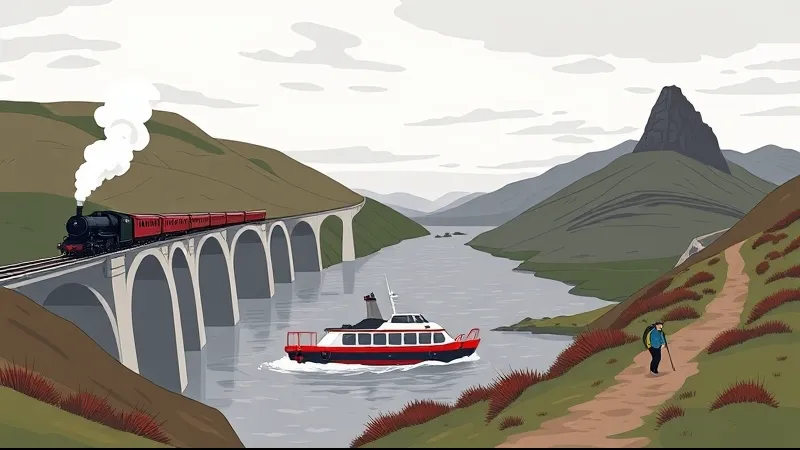
Can you combine the Jacobite Steam Train with a trip to the Isle of Skye?
Yes, but they are two separate legs, not one product. The Jacobite runs Fort William to Mallaig and back along the West Highland Line; Mallaig is a Caledonian MacBrayne ferry port for Armadale on Skye, so the island crossing is a different ticket on a different operator. In practice travellers do one of two things: assemble the trip themselves (rail, then ferry, then island bus), or take a multi-day guided tour from Edinburgh or Inverness and book the steam train separately as an add-on around it.
Three things to accept before you plan. First, a seat on the Jacobite is never guaranteed by any tour — the operator, West Coast Railways, states that seats on the day of travel "can never be guaranteed" and that "There are not many seats". Second, the service is seasonal. Third, the Glenfinnan Viaduct is crossed year-round by ordinary ScotRail services on the same track, for standard fares.
So the honest framing is: the steam train is a scenic excursion that happens to end at a Skye ferry port. It is not transport to Skye.
Where does the Jacobite run, and how does that line relate to Skye?
The Jacobite runs from Fort William west to Mallaig and returns the same way, crossing the Glenfinnan Viaduct and following the Road to the Isles corridor to the harbour town that faces Skye across the Sound of Sleat. It does not cross to the island.
The viaduct has 21 arches, stands over 30 metres above the valley floor and was completed in 1901; it is a concrete structure, and its listing details are held by Historic Environment Scotland, with visitor information from the National Trust for Scotland.
For scheduled timings, use the operator rather than an estimate. West Coast Railways publishes a morning service leaving Fort William 10:15 and arriving Mallaig 12:25, returning 14:10–16:03, plus an afternoon service in the high-summer window departing 12:50, arriving 15:06, returning 17:00–18:52. Fares published by the operator are adult standard return £76.00, first class £116.00, child standard £43.00, with a booking fee from £3.75 and a £15.00 admin fee per change; the operator notes these are "correct at time of publication (December 2025) and are subject to change", so check the booking page before you commit.
How do you get from Mallaig to Skye once the train arrives?
By the CalMac Mallaig–Armadale crossing, which takes 30 minutes and carries both foot passengers and vehicles. CalMac publishes six sailings a day from Mallaig in summer and two in winter, states that "Booking is essential on this route", and asks for check-in 20 minutes before departure for vehicles and 10 minutes for foot passengers. Published fares are adult £4.00 single / £8.00 return, child 5–15 £2.00 / £4.00, car £13.25 / £26.50 — verify on the operator's own page, as fares and patterns change with the timetable season.
The winter pattern is materially thinner than the summer one, so always read the live timetable rather than a blog table. Onward from Armadale, Stagecoach island services run via Broadford towards Portree. The connection is the weak link: ferry and bus timings do not reliably dovetail with the Jacobite's afternoon return, and missing one link can cost you the evening.
The alternative is the land route via Kyle of Lochalsh and the Skye Bridge. The bridge tolls were revoked in 2005 and it is free to cross. Coach and rail both serve this corridor — see our getting there page for how the pieces connect.
What does a realistic combined itinerary look like over three to five days?
It looks like a Skye trip with a Fort William day bolted on — not a single loop. A day trip from Edinburgh or Inverness cannot include both the steam train and meaningful time on Skye. Guided multi-day tours build their routing around the Skye Bridge, not around Mallaig.
- Edinburgh-based, four to five days. Travel to Fort William (rail via Glasgow, or the sleeper), overnight there, take the morning Jacobite, then cross from Mallaig to Armadale the same afternoon and sleep on Skye. Two days on the island, then out via the bridge and Kyle of Lochalsh.
- Inverness-based, three to four days. Skye first via the bridge, then east and south to Fort William for a steam train day. This works better in reverse than most people expect, because it removes the pressure of catching one specific train on arrival day.
- Fort William-based, no car. Sleep in Fort William, ride the Jacobite return, then use the scheduled ScotRail service to Mallaig the next morning for the first sailing to Armadale, continuing by island bus.
Every stop above is provisional. Weather, ferry status and road conditions re-order or trim itineraries routinely, and a plan that only works if nothing slips is not a plan.
Why is a seat on the Jacobite never guaranteed?
Because it is a private charter service with limited capacity, not a walk-up train. West Coast Railways states that seats on the day of travel "can never be guaranteed" and that "There are not many seats", and its published terms cover changes and cancellations — including a £15.00 admin fee per amendment.
Steam haulage itself is also not promised. The operator notes that in extreme heat the service can be suspended, and that at times of high fire risk or locomotive trouble the train may be hauled by a heritage diesel instead. Services can be cancelled for operational or safety reasons.
Crucially, multi-day tour operators do not hold seat inventory on this train. You book the rail ticket yourself and build the rest around it — and if the rail side falls over, the tour still runs. That asymmetry is the single most misunderstood part of a combined trip. Comparison of the formats sits on our 3-day Skye tours from Edinburgh page.
What are the alternatives if the Jacobite is sold out or out of season?
The scheduled ScotRail Fort William–Mallaig service: same track, same viaduct, standard fares, bookable at short notice, and running when the steam train is not. Published journey time is 1h22–1h25. For many travellers this is simply the better tool — it is cheaper, more flexible, and it fits an itinerary instead of dictating one.
A second scenic option is the Inverness–Kyle of Lochalsh line, 2h38–2h41 with only three services a day, which lands you far closer to Skye than Mallaig does. Both are on the ScotRail network map.
At ground level, the Glenfinnan Station Museum and the viaduct viewpoint trail let you watch the line rather than ride it.
How does the Glenfinnan Viaduct viewpoint work if you are not on the train?
You park at the National Trust for Scotland site and walk up. NTS publishes the current parking and admission charges and the viewpoint trail details on its Glenfinnan Monument page — read them there, because charges are revised and we will not quote a figure we cannot verify.
Practical warnings: the car park fills quickly in summer, and roadside parking arrangements are set out by NTS on the same page. No timetable guarantees a steam locomotive will cross while you are standing there, and low cloud regularly hides the structure. The walk is worth doing regardless; the photograph is not promised.
How do you reach Fort William, Mallaig or Skye without a car?
On a thin but workable public transport spine. Published journey times: Glasgow–Fort William 3h46–3h47, Fort William–Mallaig 1h22–1h25, Edinburgh–Inverness 3h29 direct (six directs a day Mon–Fri), Glasgow–Inverness 3h17, Inverness–Kyle of Lochalsh 2h38–2h41. The Caledonian Sleeper also serves Fort William.
By coach, Scottish Citylink services run towards Portree and Uig: Glasgow–Portree 6h25, Inverness–Portree 3h12–3h20 with four services a day in summer, Fort William–Portree 3h05, Portree–Uig 27 minutes. There is no direct coach from Edinburgh to Portree — you need at least two legs via Glasgow or Inverness.
Check each operator's live timetable rather than any reproduced departure list, since patterns change twice a year. Island buses have real luggage limits, Sunday services are sparse, and these gaps are precisely why guided multi-day tours from Edinburgh and Inverness exist. Availability and current prices for those sit in the widgets on the tour pages, including the 4-day Skye and Jacobite Steam Train tour.
When does the Jacobite operate, and how should that shape a year-round plan?
Seasonally — broadly spring through autumn, with a morning service across the season and an additional afternoon departure in the high-summer window only. State the operating window from the West Coast Railways timetable page rather than from any secondary listing.
The planning consequence is simple. In winter, the steam train is not part of the equation. A winter Skye trip is built on the Skye Bridge, the Kyle of Lochalsh line and coach services, with the scheduled ScotRail run to Mallaig available if you still want the viaduct.
How does weather change a combined rail, ferry and Skye itinerary?
It changes it often, and the Met Office averages show why. Skye (Prabost, near Portree) records 1769.05 mm of rain a year against 755.02 mm at Inverness; the wettest month is January at 208.52 mm, the driest June at 82.15 mm, with July 102.38 mm and August 124.89 mm. Sunshine totals 1200.34 hours a year, best in May (195.83), worst in December (30.72). August averages a maximum of 17.09°C. Western and northern parts of northern Scotland are on average the windiest of the UK, strongest December to February. Overcast and breezy is the norm, not bad luck.
Three concrete disruption mechanisms:
- CalMac cancels or amends sailings in high winds — check the live service status page before travelling to Mallaig or Armadale.
- Attractions close on wind grounds. Dunvegan Castle states its estate may close castle and gardens at short notice in high winds.
- The Quiraing road (C1225) is closed overnight in winter for snow and ice pending treatment. Highland Council treats priority 1 routes 06:00–21:00, priority 2 06:00–18:00 and minor rural roads "as resources allow", with no overnight service; check Traffic Scotland for live road status.
Build a spare half-day into any three-to-five day plan and treat every named stop as replaceable.
Which Skye walks fit around a rail-based itinerary, and how hard are they?
Harder than the photographs suggest. Published grades and distances:
- Old Man of Storr — 3.8 km; the site manager advises allowing at least 2 hours return and describes the path as "steep and exposed", with gravel then steep uneven rock steps and a permanent danger of rockfall higher up. Parking £6.00 up to 6 hours, £8.00 up to 12 hours, 140 vehicles of capacity, free toilets (thestorr.com).
- Quiraing — a 6.8 km loop of about 2 hours, classified Medium for length but Hard for difficulty, with steep grassy slopes, mud, scree and long stretches very close to the cliff edge; "not suitable in all weather conditions". Car park 40 spaces, £3.00 up to 3 hours, £6.00 up to 6 hours.
- Fairy Pools — 2.4 km return, 40 minutes to 1 hour 30, Short for length and Medium for difficulty; stones get slippery when wet and about 240,000 people a year come. Access free; parking car £8.00, motorcycle £4.00, campervan £10.00, 177 spaces.
- Neist Point — 2.2 km, about 45 minutes, a concrete path very steep in places with a demanding climb back near the cliffs. The lighthouse dates from 1909; the Northern Lighthouse Board states there is no public access to the tower.
The Cuillin are not a hike. Sgurr Alasdair is 992 m, the Black Cuillin ridge runs over 11 km with 11 Munros, and the compass can read wrong because of the iron in the rock; Mountaineering Scotland and the destination body recommend going with a guide. Note also that no avalanche forecast covers Skye — the SAIS service covers six areas and the Cuillin are not among them. Boots and waterproofs are not optional. Grades and distances are cross-checkable on WalkHighlands; parking charges should be re-checked with the operators.
Should you sleep in Portree, Broadford, Fort William or Mallaig?
It depends on which connection you need to protect.
- Fort William — the base for an early Jacobite departure, and the only sensible one if you have a morning train booked.
- Mallaig — the base for a first-sailing ferry, useful if you want the whole of arrival day on Skye.
- Broadford — bridge-side access and the southern half of the island, closest to Armadale.
- Portree — bus connections and the northern loop, including Storr and the Quiraing. Portree has 2,281 inhabitants (2022 census) and its name comes from the Gaelic Port Righ.
Island accommodation books out well ahead in summer, and a fixed hotel booking is the least flexible element in a weather-driven itinerary — the more nights you pin, the less you can react. Live availability belongs on the hotels page rather than in prose.
Which type of trip suits which traveller?
- Rail enthusiasts and families chasing the viaduct crossing — book the Jacobite first, build everything else around that date, and hold the scheduled ScotRail service as your fallback.
- First-time visitors with limited days — skip the steam train. Two days is not enough for both, and Skye rewards the time more.
- No-car travellers — a guided multi-day tour is often the pragmatic choice: no single-track driving, no ferry logistics, no Sunday bus gaps. Independent rail travel wins on flexibility and lower commitment.
- Photographers — the viewpoint at Glenfinnan, not a seat on the train; you cannot photograph the viaduct from the train crossing it.
If you are weighing formats, compare a day trip against a multi-day tour — availability and current prices are in the widgets on each tour page, not in this article.
Frequently asked questions about combining the Jacobite and the Isle of Skye
Does the Jacobite Steam Train go to the Isle of Skye?
No. It runs Fort William to Mallaig and back. Mallaig is a CalMac port for Armadale on Skye, and the crossing is a separate ticket.
Can I do the steam train and Skye in one day?
Not meaningfully. Adding the 30-minute ferry and island bus travel to the train's own timings leaves almost no daylight on the island, and the return sailing constrains you further.
Is the Jacobite the Hogwarts Express?
The route crosses the Glenfinnan Viaduct familiar from the films, but the Jacobite is a scheduled seasonal excursion operated by West Coast Railways, not a film attraction. Ordinary ScotRail services cross the same viaduct year-round.
Do I need to book the train in advance?
Yes — treat it as a booked excursion. West Coast Railways states that seats on the day of travel "can never be guaranteed" and that "There are not many seats".
What happens if the ferry is cancelled?
CalMac amends or cancels sailings in high winds; check the live service status page. The land alternative is the Skye Bridge via Kyle of Lochalsh, which adds a substantial detour by coach or rail.
Can I take luggage on the train and the ferry?
The ferry is straightforward for foot passengers, but island buses have real luggage limits. Check the operators' published conditions before travelling with large cases.
Is there a toll on the Skye Bridge?
No. The Skye Bridge tolls were revoked in 2005 and the crossing is free.
Do multi-day tours include the steam train?
No tour holds seat inventory on the Jacobite. Where a tour is designed around it, you book the rail ticket yourself, and a rail-side cancellation does not cancel the tour.
Can I see the viaduct without a train ticket?
Yes, from the National Trust for Scotland viewpoint trail at Glenfinnan. No timetable guarantees a steam locomotive will pass while you are there, and low cloud often hides the structure.
Which walks are suitable for children?
The Fairy Pools (2.4 km return) and Neist Point (2.2 km) are shorter, but both involve rough ground; the Fairy Pools stones are slippery when wet. The Quiraing is graded Hard for difficulty with long stretches close to the cliff edge and is not a family stroll.
Sources
Last verified: December 2025 for Jacobite fares and timetable (as published by the operator). Re-check all timetables and charges before publication in each language.
- West Coast Railways — Jacobite timetable, operating season, fares and booking terms
- ScotRail — West Highland Line and Inverness–Kyle of Lochalsh services
- Caledonian MacBrayne and live service status — Mallaig–Armadale timetable, fares, disruption
- Scottish Citylink and Stagecoach — coach and island bus timetables
- National Trust for Scotland – Glenfinnan — viewpoint trail, parking and admission charges
- Historic Environment Scotland — Glenfinnan Viaduct listing
- Met Office UK climate averages — rainfall, sunshine, temperature and wind (1991–2020)
- Traffic Scotland — live road status and winter closures
- WalkHighlands – Skye and NatureScot — route lengths and difficulty grades
- Mountaineering Scotland — Cuillin safety guidance; SAIS — avalanche forecast areas (Skye not covered)
- The Storr — Old Man of Storr path description and parking charges
- The Highway Code — single-track road rules; VisitScotland and The Highland Council — parking and visitor management